Price in Bangladesh
৳ 50.00 unit price
Price updated: 22 Nov 2026
- Strength
- 2 mg
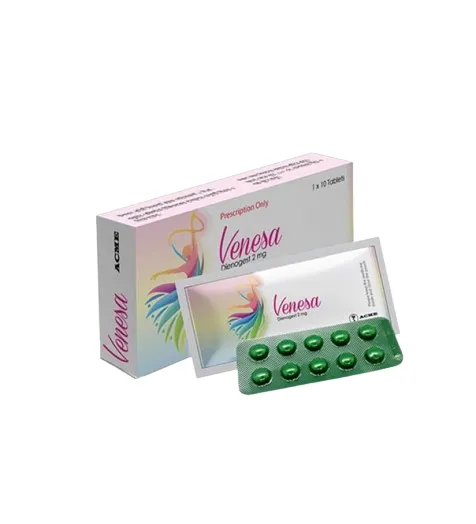
About Venesa 2 mg Tablet
Venesa 2 mg is a tablet product of ACME Laboratories Ltd. that contains Dienogest. Dienogest reduces the effect of estrogen on the lining of the uterus and on breast tissue, and it also acts on endometrial tissue that grows outside the uterus.
There are 7 brands of Dienogest listed in Bangladesh. By unit price, Venesa is among the cheapest of them. The lowest listed price is Femogest 2 mg Tablet at ৳ 50.00 per unit.
What is Venesa 2 mg Tablet?
Venesa 2 mg tablet is a medicine made by ACME Laboratories Ltd. Dienogest lowers the effect of estrogen on endometrial tissue and reduces its growth. The tablet is taken continuously, and the doctor decides the dose and course of treatment. Always follow your doctor's advice and ask your pharmacist if you have questions.
Uses of Venesa
Dienogest reduces the effect of estrogen on the lining of the uterus and on breast tissue, and it also acts on endometrial tissue that grows outside the uterus. It may help reduce symptoms linked to endometriosis, but response varies from person to person. Many women notice changes in their bleeding pattern during treatment. Do not change or stop the treatment on your own.
How to use Venesa
Take Venesa 2 mg tablet exactly as your doctor prescribes. Swallow the tablet with water. Venesa is taken by mouth. If a dose is missed, ask the doctor or pharmacist what to do. If you miss a tablet or vomit after taking it, ask your doctor or pharmacist what to do. The doctor decides the dose and how long you take it.
Side effects of Venesa
Some people may also experience nausea, migraine, palpitations, low blood pressure, or changes in bleeding patterns. If any side effect bothers you or does not go away, tell your doctor. The most commonly reported ones include headache, breast discomfort, depressed mood, and acne. Contact your doctor if you notice anything unusual after taking it.
Safety and precautions
Use a non-hormonal contraceptive method if needed during treatment. Do not use this medicine if you are pregnant or breastfeeding, as it is not recommended during these times. Before starting Venesa, pregnancy must be excluded. Ask your doctor first if you are pregnant, planning pregnancy or breastfeeding.
Frequently asked questions
What is Venesa used for?
Dienogest reduces the effect of estrogen on the lining of the uterus and on breast tissue, and it also acts on endometrial tissue that grows outside the uterus. It may help reduce symptoms linked to endometriosis, but response varies from person to person.
How do I use Venesa correctly?
Take Venesa 2 mg tablet exactly as your doctor prescribes. Swallow the tablet with water.
What should I watch for while using Venesa?
Some people may also experience nausea, migraine, palpitations, low blood pressure, or changes in bleeding patterns. If any side effect bothers you or does not go away, tell your doctor.
How much does Venesa cost in Bangladesh?
The listed price is ৳ 50.00.
Indications
Dienoaest is indicated for the treatment of endometriosis. This is the preparation of Dienogest which belongs to the class of medications called progestins. Progestins reduce the effects of estrogen on tissues such as the endometrium (lining of the uterus) and the breast. By reducing the growth effect ... Read moreDienoaest is indicated for the treatment of endometriosis. This is the preparation of Dienogest which belongs to the class of medications called progestins. Progestins reduce the effects of estrogen on tissues such as the endometrium (lining of the uterus) and the breast. By reducing the growth effect of estrogen on the endometrium, Dienogest helps to reduce the pelvic pain experienced by women with endometriosis.
Pharmacology
Dienogest acts as an agonist at the progesterone receptor (PR) with weak affinity that is comparable to that of progesterone but has a very potent progestagenic effect in the endometrium, causing endometrial atrophy after prolonged use. It promotes antiproliferative, immunologic and antiangiogenic effects on endometrial tissue. Dienogest reduces the level of endogenous production of oestradiol and thereby suppressing the trophic effects of oestradiol on both the eutopic and ectopic endometrium. Continous administration of dienogest results in hyperprogestogenic and moderately hypoestrogenic endocrine environment, which causes initial decidualization of endometrial tissue. It is an antagonist at androgen receptors, improve androgenic symptoms such as acne and hirsutism [A16570].
Dosage & Administration
Tablet-taking can be started on any day of the menstrual cycle. The dosage of Dienogest is 2 mg daily without any break, taken preferably at the same time each day with some liquid as needed. Tablet must be taken continuously without regard to vaginal bleeding. When a pack is finished, the next one should be started without interruption.
In the event of missed tablet(s), the woman should take 2 mg only, as soon as she remembers, and should then continue the next day to take the tablet at her usual time. A tablet not absorbed due to vomiting or diarrhea should likewise be replaced by 2 mg.
Interaction
Progestogens including Dienogest are metabolized mainly by the cytochrome P450 3A4 system . Therefore, inducers or inhibitors of CYP3A4 may affect the progestogen drug metabolism. Known CYP3A4 inhibitors like azole antifungals (e.g, ketoconazole, itraconazole, fluconazole), cimetidine, verapamil, macrolides (e.g, erythromycin, clarithromycin and roxithromycin), diltiazem, protease inhibitors (e.g, ritonavir, saquinavir, indinavir, nelfinavir), antidepressants (e.g, nefazodone, fluvoxamine, fluoxetine) may increase plasma levels of progestogens and result in adverse reactions.
Contraindications
Hypersensitivity to dienogest or to any of the excipients of Dienogest. Dienogest should not be used in the presence of any of the conditions such as, Active venous thromboembolic disorder; arterial and cardiovascular disease, (e.g, myocardial infarction, cerebrovascular accident, ischemic heart disease); diabetes mellitus with vascular involvement; presence or history of severe hepatic disease as long as liver function values have not returned to normal; presence or history of liver tumors (benign or malignant); known or suspected sex hormone-dependent malignancies and undiagnosed vaginal bleeding.
Side Effects
Undesirable effects are more common during the 1st months after start of intake of Dienogest, and subside with duration of treatment. The following undesirable effects have been reported in users of Dienogest. The most frequently reported undesirable effects during treatment that were considered at least possibly related to Dienogest were headache (9%), breast discomfort (5.4%), depressed mood (5.1%) and acne (5.1%).
- Nervous System Disorders: Headache, migraine.
- Cardiac Disorders: Uncommon: Unspecified circulatory system disorder, palpitations.
- Vascular Disorders: Uncommon: Hypotension.
- Gastrointestinal Disorders: Common: Nausea, abdominal pain, flatulence.
- Metabolism and nutrition disorders: Weight increase (3.6%)
- Psychiatric Disorders: Depressed mood, irritability, nervousness, altered mood.
Pregnancy & Lactation
There are limited data from the use of Dienogest in pregnant women. Animal studies and data from women exposed to Dienogest during pregnancy reveal no special risks on pregnancy, embryonic/fetal development, birth or development after birth for humans. However, Dienogest should not be administered to pregnant women because there is no need to treat endometriosis during pregnancy.
Treatment with Dienogest during lactation is not recommended. Physiochemical properties and animal data indicate excretion of Dienogest in breast milk. A decision must be made whether to discontinue breastfeeding or to abstain from Dienogest therapy taking into account the benefit of breastfeeding for the child and the benefit of therapy for the woman.
Precautions & Warnings
Before starting Dienogest treatment, pregnancy must be excluded. During treatment, patients are advised to use nonhormonal methods of contraception (e.g, barrier method) if contraception is required.
As Dienogest is a progestogen-only preparation, it can be assumed that special warnings and special precautions for use of other progestogen-only preparations are also valid for the use of Dienogest .
- Changes in Bleeding Pattern: Dienogest treatment affects the menstrual bleeding pattern in the majority of women.
- Hepatic Impairment: Dienogest is contraindicated in patients with present or past severe hepatic disease.
- Impairment of Fertility: Based on available data, ovulation is inhibited in the majority of patients during treatment with Dienogest. However, Dienogest is not a contraceptive. If contraception is required, a nonhormonal method should be used.
Overdose Effects
Acute toxicity studies performed with Dienogest did not indicate a risk of acute adverse effects in case of inadvertent intake of a multiple of the daily therapeutic dose. There is no specific antidote. Dienogest 20-30 mg/day (10-15 times higher dose than in Dienogest) over 24 weeks of use were very well tolerated.
Storage Conditions
Keep in a cool and dry place. Protect from light. Keep out of the reach of children.
Medicine information is for reference only and is not medical advice. Always follow your doctor's prescription and check with a pharmacist.