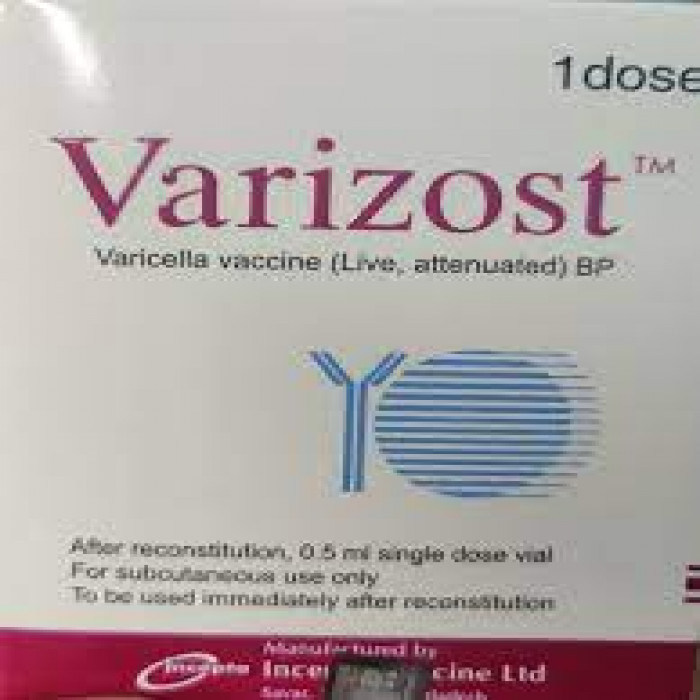
Price in Bangladesh
৳ 1400.00 unit price
Price updated: 22 Nov 2026
- Strength
- 0.5 ml/vial
About Varizost 0.5 ml/vial SC Injection
Varizost is a sc injection from Incepta Pharmaceuticals Ltd., with the generic name Varicella Virus Vaccine. Varizost contains Varicella Virus Vaccine, which belongs to the Vaccines, Anti-sera & Immunoglobulin group of medicines.
What is Varizost 0.5 ml/vial SC Injection?
Varizost 0.5 ml/vial sc injection is a medicine made by Incepta Pharmaceuticals Ltd. The relative contributions of humoral immunity and cell-mediated immunity to protection from varicella are unknown. Varicella Virus Vaccine induces both cell-mediated and humoral immune responses to varicella-zoster virus. Use it only as your doctor directs.
Uses of Varizost
Varizost contains Varicella Virus Vaccine, which belongs to the Vaccines, Anti-sera & Immunoglobulin group of medicines. Ask your doctor whether it is right for your condition.
How to use Varizost
Do not inject it yourself unless a doctor has shown you how. Varizost is given as an injection by a healthcare professional. Swallow the sc injection with water as directed. Complete the course exactly as prescribed. Do not change the dose or stop early without asking your doctor.
Side effects of Varizost
Other reported adverse reactions in all age groups include varicella-like rash (injection site) and varicella-like rash (generalized). Contact your doctor if you notice anything unusual after taking it. Tell your doctor if any side effect bothers you or does not go away.
Safety and precautions
Varicella Virus Vaccine is contraindicated for use in pregnant women because the vaccine contains live, attenuated varicella virus, and it is known that wild-type varicella virus, if acquired during pregnancy. For preventive vaccines, the underlying maternal condition is susceptibility to disease prevented by the vaccine. Active Untreated Tuberculosis : Do not administer Varicella Virus Vaccine to individuals with active, untreated tuberculosis (TB). Tell your doctor about all the other medicines you take.
Frequently asked questions
Why is Varizost prescribed?
Varizost contains Varicella Virus Vaccine, which belongs to the Vaccines, Anti-sera & Immunoglobulin group of medicines. Ask your doctor whether it is right for your condition.
How should I take Varizost?
Do not inject it yourself unless a doctor has shown you how. Varizost is given as an injection by a healthcare professional.
What should I watch for while using Varizost?
Other reported adverse reactions in all age groups include varicella-like rash (injection site) and varicella-like rash (generalized). Contact your doctor if you notice anything unusual after taking it.
What is the price of Varizost?
The listed price is ৳ 1400.00.
Indications
This is a vaccine indicated for active immunization for the prevention of varicella in individuals 12 months of age and older.
Pharmacology
Varicella Virus Vaccine induces both cell-mediated and humoral immune responses to varicella-zoster virus. The relative contributions of humoral immunity and cell-mediated immunity to protection from varicella are unknown.
Dosage & Administration
Each 0.5 mL dose of Varicella Virus Vaccine is administered subcutaneously. Inject the vaccine subcutaneously into the outer aspect of the deltoid region of the upper arm or into the higher anterolateral area of the thigh.
Children (12 months to 12 years of age): The first dose is administered at 12 to 15 months of age but may be given anytime through 12 years of age. The second dose is administered at 4 to 6 years of age. At least 3 months should elapse between a dose of varicella-containing vaccine. At least 1 month should elapse between a dose of measles-containing vaccine and a dose of Varicella Virus Vaccine if the vaccines are not given concurrently.
Adolescents (≥13 years of age) and Adults: Two doses of Varicella Virus Vaccine are administered at a minimum interval of 4 weeks.
Interaction
Reye syndrome has been reported in children and adolescents following the use of salicylates during wild-type varicella infection. Administration of immune globulins and other blood products concurrently with Varicella Virus Vaccine vaccine may interfere with the expected immune response. Varicella Virus Vaccine vaccination may result in a temporary depression of purified protein derivative (PPD) tuberculin skin sensitivity.
Contraindications
Severe Allergic Reaction: Do not administer Varicella Virus Vaccine to individuals with a history of anaphylactic or severe allergic reaction to any component of the vaccine (including neomycin and gelatin) or to a previous dose of a varicella-containing vaccine.
Immunosuppression: Do not administer Varicella Virus Vaccine to individuals who are immunodeficient or immunosuppressed due to disease or medical therapy. Disseminated varicella disease and extensive vaccine associated rash have been reported in individuals who are immunosuppressed or immunodeficient who were inadvertently vaccinated with a varicella-containing vaccine.
Moderate or Severe Febrile Illness: Do not administer Varicella Virus Vaccine to individuals with an active febrile illness with fever >38.5°C.
Active Untreated Tuberculosis: Do not administer Varicella Virus Vaccine to individuals with active, untreated tuberculosis (TB).
Pregnancy: Do not administer Varicella Virus Vaccine to individuals who are pregnant or planning on becoming pregnant in the next 3 months. Wild-type varicella is known to cause fetal harm.
Side Effects
Frequently reported (≥10%) adverse reactions in children ages 1 to 12 years include:
- fever ≥102.0°F (38.9°C) oral: 14.7%
- injection-site complaints: 19.3%
Frequently reported (≥10%) adverse reactions in adolescents and adults ages 13 years and older include:
- fever ≥100.0°F (37.8°C) oral: 10.2%
- injection-site complaints: 24.4%
Other reported adverse reactions in all age groups include:
- varicella-like rash (injection site)
- varicella-like rash (generalized)
Pregnancy & Lactation
Varicella Virus Vaccine is contraindicated for use in pregnant women because the vaccine contains live, attenuated varicella virus, and it is known that wild-type varicella virus, if acquired during pregnancy, can cause congenital varicella syndrome. No increased risk for miscarriage, major birth defect or congenital varicella syndrome was observed in a pregnancy exposure registry that monitored outcomes after inadvertent use. There are no relevant animal data.
It is not known whether varicella vaccine virus is excreted in human milk. The developmental and health benefits of breastfeeding should be considered along with the mother’s clinical need for Varicella Virus Vaccine, and any potential adverse effects on the breastfed child from Varicella Virus Vaccine or from the underlying maternal condition. For preventive vaccines, the underlying maternal condition is susceptibility to disease prevented by the vaccine.
Precautions & Warnings
Evaluate individuals for immune competence prior to administration of Varicella Virus Vaccine if there is a family history of congenital or hereditary immunodeficiency. Avoid close contact with high-risk individuals susceptible to varicella because of possible transmission of varicella vaccine virus. Immune Globulins (IG) and other blood products should not be given concomitantly with Varicella Virus Vaccine. Avoid use of salicylates for 6 weeks following administration of Varicella Virus Vaccine to children and adolescents.
Storage Conditions
Store between 2-8° C. Do not freeze. Protect from light. Keep out of the reach of children.
Medicine information is for reference only and is not medical advice. Always follow your doctor's prescription and check with a pharmacist.