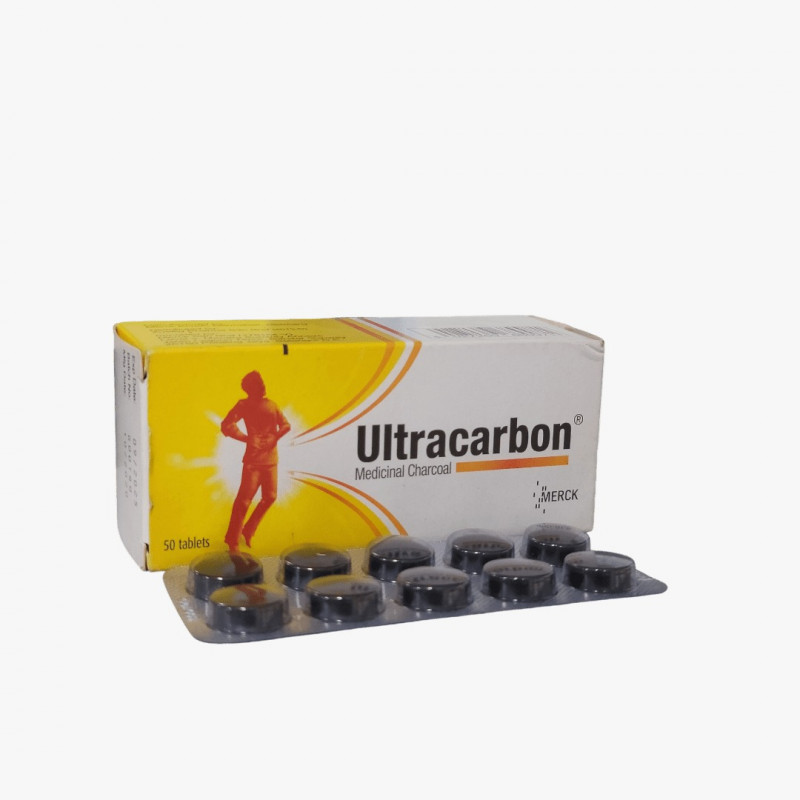
Price in Bangladesh
৳ 13.8 unit price
Price updated: 22 Nov 2026
- Strength
- 250 mg
About Ultracarbon 250 mg Tablet
Ultracarbon 250 mg is a tablet product of Merck that contains Activated Charcoal. Diarrhoea & poisoning due to foods, heavy meals & drugs.
There are 2 brands of Activated Charcoal listed in Bangladesh. 1 of them has a lower unit price than Ultracarbon.
What is Ultracarbon 250 mg Tablet?
Ultracarbon 250 mg tablet is a medicine made by Merck. Active charcoal binds the poison and prevents its absorption by the gastrointestinal tract. In rare situations, it may also be used in a hemoperfusion system to remove toxins from the blood stream of poisoned patients. Use it only as your doctor directs.
Uses of Ultracarbon
Diarrhoea & poisoning due to foods, heavy meals & drugs. Ask your doctor whether it is right for your condition.
How to use Ultracarbon
Swallow the tablet with water. Ultracarbon is taken by mouth. Complete the course exactly as prescribed. If you miss a dose, ask your doctor or pharmacist what to do.
Side effects of Ultracarbon
After very high doses as those taken in intoxications, constipation and intestinal obstruction (mechanical ileus) may occur in individual cases; this can be prevented by administering saline laxatives (eg, sodium sulfate). No adverse reactions to Ultracarbon are known to occur if taken in the recommended dosage to treat the diarrhoea. As most undesirable effects are based on post-marketing spontaneous reporting, precise frequency estimation is not possible. Contact your doctor if you notice anything unusual after taking it. Tell your doctor if any side effect bothers you or does not go away.
Safety and precautions
In many intoxications, a specific antidote must be administered additionally to medicinal charcoal (eg, acetylcysteine in paracetamol poisoning). To avoid aspiration in unconscious patients, a physician should administer the suspension of Ultracarbon tablets in water by gastric tube. In patients undergoing multiple dose, Activated Charcoal therapy after intoxication, gastrointestinal sounds should be monitored frequently to assess peristaltic action. Tell your doctor about all the other medicines you take.
Frequently asked questions
Why is Ultracarbon prescribed?
Diarrhoea & poisoning due to foods, heavy meals & drugs. Ask your doctor whether it is right for your condition.
How do I use Ultracarbon correctly?
Swallow the tablet with water. Ultracarbon is taken by mouth.
What should I watch for while using Ultracarbon?
After very high doses as those taken in intoxications, constipation and intestinal obstruction (mechanical ileus) may occur in individual cases; this can be prevented by administering saline laxatives (eg, sodium sulfate). No adverse reactions to Ultracarbon are known to occur if taken in the recommended dosage to treat the diarrhoea.
How much does Ultracarbon cost in Bangladesh?
The listed price is ৳ 13.8.
Indications
Diarrhoea & poisoning due to foods, heavy meals & drugs. Flatulence due to diet & other factors.
Pharmacology
Active charcoal binds the poison and prevents its absorption by the gastrointestinal tract. In cases of suspected poisoning, medical personnel administer activated carbon on the scene or at a hospital's emergency department. In rare situations, it may also be used in a hemoperfusion system to remove toxins from the blood stream of poisoned patients. Activated carbon has become the treatment of choice for many poisonings, and other decontamination methods such as ipecac-induced emesis or stomach pumping are now used rarely. It interrupts the enterohepatic and enteroenteric circulation of some drugs/toxins and their metabolites.
Dosage & Administration
Diarrhoea:
- Adult: 2-4 tab tds-qds.
- Children: ½ adult dose.
Poisoning:
- Adult: 2-4 tab/kg body weight
- children: 3-4 tab/kg body weight
Flatulence:
- Adult: Disintegrate 1-2 tab. Repeat every 2 hr.
Interaction
Ultracarbon should not be administered together with other drugs because their efficacy can be reduced.
Contraindications
Febrile diarrhoea. Medicinal charcoal should not be taken in the case of intoxication with corrosive substances (strong acids and alkalis) as this would complicate diagnostic measures eg, oesophagoscopy and gastroscopy.
Side Effects
As most undesirable effects are based on post-marketing spontaneous reporting, precise frequency estimation is not possible. No adverse reactions to Ultracarbon are known to occur if taken in the recommended dosage to treat the diarrhoea. After very high doses as those taken in intoxications, constipation and intestinal obstruction (mechanical ileus) may occur in individual cases; this can be prevented by administering saline laxatives (eg, sodium sulfate). As medicinal charcoal is excreted in unchanged form, the stools turn black (discoloured faeces) after intake of Ultracarbon tablets.
Precautions & Warnings
Several poisons and drugs require different or additional measures. Medicinal charcoal is not effective in intoxications with organic and inorganic salts as well as solvents eg, for instance, lithium, thallium, cyanide, iron salts, methanol, ethanol and ethylene glycol. Different measures are in these cases indicated to eliminate the poison (eg, gastric lavage).
In many intoxications, a specific antidote must be administered additionally to medicinal charcoal (eg, acetylcysteine in paracetamol poisoning).
To avoid aspiration in unconscious patients, a physician should administer the suspension of Ultracarbon tablets in water by gastric tube.
In patients undergoing multiple dose, activated charcoal therapy after intoxication, gastrointestinal sounds should be monitored frequently to assess peristaltic action.
Ultracarbon should not be used in cases of poisoning with pesticides.
Overdose Effects
Activated charcoal is well tolerated and due to its lack of toxicity, overdose requiring treatment is unlikely. Should symptoms of overdose like constipation and intestinal obstruction (mechanical ileus) occur, a saline laxative may be administered to enhance the elimination of Ultracarbon tablets.
Storage Conditions
Do not store above 30°C.
Medicine information is for reference only and is not medical advice. Always follow your doctor's prescription and check with a pharmacist.