Price in Bangladesh
৳ 35.00 unit price
Price updated: 22 Nov 2026
- Strength
- 25 mg
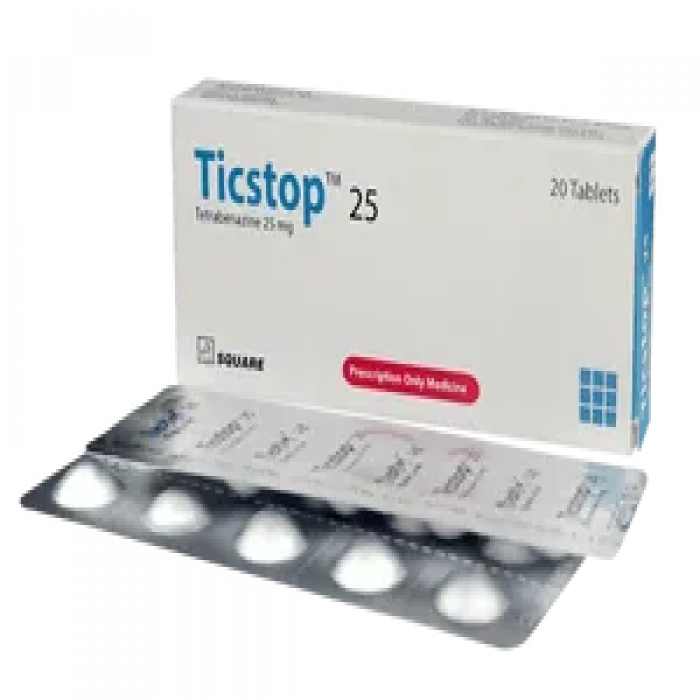
About Ticstop 25 mg Tablet
Made by Square Pharmaceuticals PLC., Ticstop is a tablet whose active ingredient is Tetrabenazine. The medicine is meant for people with this condition and is prescribed by a doctor.
There are 13 brands of Tetrabenazine listed in Bangladesh. 5 of them have a lower unit price than Ticstop. The lowest listed price is Ticstop 12.5 Tablet at ৳ 20 per unit.
What is Ticstop 25 mg Tablet?
Ticstop comes as a tablet with 25 mg of Tetrabenazine, from Square Pharmaceuticals PLC. It is prescribed for chorea, the involuntary jerky movements that can occur in Huntington's disease. The medicine lowers the levels of certain chemical messengers in the brain that are involved in movement control. Use it only as your doctor directs.
Uses of Ticstop
The medicine is meant for people with this condition and is prescribed by a doctor. If you have questions about what it is used for, ask your doctor or pharmacist. It is not a general treatment for other movement problems. Your doctor will decide if it is suitable for you.
How to use Ticstop
The doctor sets the dose and course for each person and may adjust it gradually over time. Ticstop is taken by mouth. Swallow the tablet with water. Swallow the tablet as your doctor or pharmacist advises. Complete the course exactly as prescribed. Do not change the dose yourself.
Side effects of Ticstop
Depression and suicidal thoughts are serious concerns with this medicine. Seek medical help right away if these occur or worsen. Side effects to watch for include restlessness, agitation, unusual movements, parkinsonism-like stiffness or tremor, difficulty swallowing, and drowsiness. The doctor will decide how to manage any side effect. Tell your doctor promptly if you notice low mood, thoughts of self-harm, unusual restlessness, or trouble swallowing.
Safety and precautions
It may worsen parkinsonism, so tell the doctor about any such condition. Always ask the doctor or pharmacist first about any concerns. Ticstop should not be used by people who are actively suicidal or who have untreated or poorly treated depression, by people with liver problems, or by people taking monoamine oxidase inhibitors. Keep out of reach of children.
Frequently asked questions
What does Ticstop treat?
The medicine is meant for people with this condition and is prescribed by a doctor. If you have questions about what it is used for, ask your doctor or pharmacist.
How is Ticstop used?
The doctor sets the dose and course for each person and may adjust it gradually over time. Ticstop is taken by mouth.
Can Ticstop cause side effects?
Depression and suicidal thoughts are serious concerns with this medicine. Seek medical help right away if these occur or worsen.
What is the price of Ticstop?
The listed price is ৳ 35.00.
Indications
Tetrabenazine is indicated for the treatment of chorea associated with Huntington's disease.
Pharmacology
Prolongation of the QTc interval has been observed at doses of 50 mg. In rats, it has been observed that tetrabenazine or its metabolites bind to melanin-containing tissues such as the eyes and skin. After a single oral dose of radiolabeled tetrabenazine, radioactivity was still detected in eye and fur at 21 days post dosing.
Tetrabenazine is a reversible human vesicular monoamine transporter type 2 inhibitor (Ki = 100 nM). It acts within the basal ganglia and promotes depletion of monoamine neurotransmitters serotonin, norepinephrine, and dopamine from stores. It also decreases uptake into synaptic vesicles. Dopamine is required for fine motor movement, so the inhibition of its transmission is efficacious for hyperkinetic movement. Tetrabenazine exhibits weak in vitro binding affinity at the dopamine D2 receptor (Ki = 2100 nM).
Dosage & Administration
General Dosing Considerations:
The chronic daily dose of Tetrabenazine used to treat chorea associated with Huntington's disease (HD) is determined individually for each patient. When first prescribed, Tetrabenazine therapy should be titrated slowly over several weeks to identify a dose of XENAXINE that reduces chorea and is tolerated. Tetrabenazine can be administered without regard to food.
Individualization Of Dose:
Dosing Recommendations Up to 50 mg per day: The starting dose should be 12.5 mg per day given once in the morning. After one week, the dose should be increased to 25 mg per day given as 12.5 mg twice a day. Tetrabenazine should be titrated up slowly at weekly intervals by 12.5 mg daily, to allow the identification of a tolerated dose that reduces chorea. If a dose of 37.5 to 50 mg per day is needed, it should be given in a three times a day regimen. The maximum recommended single dose is 25 mg. If adverse reactions such as akathisia, restlessness, parkinsonism, depression, insomnia, anxiety or sedation occur, titration should be stopped and the dose should be reduced. If the adverse reaction does not resolve, consideration should be given to withdrawing Tetrabenazine treatment or initiating other specific treatment (e.g., antidepressants).
Dosing Recommendations Above 50 mg per day: Patients who require doses of Tetrabenazine greater than 50 mg per day should be first tested and genotyped to determine if they are poor metabolizers (PMs) or extensive metabolizers (EMs) by their ability to express the drug metabolizing enzyme, CYP2D6. The dose of Tetrabenazine should then be individualized accordingly to their status as PMs or EMs
Extensive and Intermediate CYP2D6 Metabolizers:
Genotyped patients who are identified as extensive (EMs) or intermediate metabolizers (IMs) of CYP2D6, who need doses of Tetrabenazine above 50 mg per day, should be titrated up slowly at weekly intervals by 12.5 mg daily, to allow the identification of a tolerated dose that reduces chorea. Doses above 50 mg per day should be given in a three times a day regimen. The maximum recommended daily dose is 100 mg and the maximum recommended single dose is 37.5 mg. If adverse reactions such as akathisia, parkinsonism, depression, insomnia, anxiety or sedation occur, titration should be stopped and the dose should be reduced. If the adverse reaction does not resolve, consideration should be given to withdrawing Tetrabenazine treatment or initiating other specific treatment (e.g., antidepressants)Interaction
Tetrabenazine should not be given with or within 14 days of discontinuation of MAOI therapy. Blocks action of reserpine. Decreases effects of levodopa and worsen parkinsonism. Increased risk of extrapyramidal side effects when given with amantadine, metoclopramide, antipsychotics.
Contraindications
Tetrabenazine is contraindicated in patients:
- Who are actively suicidal, or in patients with untreated or inadequately treated depression
- With hepatic impairment
- Taking monoamine oxidase inhibitors (MAOIs). XENAZINE should not be used in combination with an MAOI, or within a minimum of 14 days of discontinuing therapy with an MAOI
Side Effects
The following serious adverse reactions are Depression, Suicidality Akathisia, restlessness, and agitation, Parkinsonism, Dysphagia, Sedation and somnolence
Pregnancy & Lactation
Pregnancy Category C. There are no adequate and well-controlled studies in pregnant women. Tetrabenazine should be used during pregnancy only if the potential benefit justifies the potential risk to the fetus.
Nursing Mothers: It is not known whether Tetrabenazine or its metabolites are excreted in human milk. Since many drugs are excreted into human milk and because of the potential for serious adverse reactions in nursing infants from Tetrabenazine, a decision should be made whether to discontinue nursing or to discontinue Tetrabenazine, taking into account the importance of the drug to the mother.
Precautions & Warnings
May exacerbate symptoms of parkinsonism. Caution to be exercised when driving or performing skilled tasks. Pregnancy.
Overdose Effects
Three episodes of overdose occurred in the open-label trials performed in support of registration. Eight cases of overdose with Tetrabenazine have been reported in the literature. The dose of Tetrabenazine in these patients ranged from 100 mg to 1g. Adverse reactions associated with Tetrabenazine overdose include acute dystonia, oculogyric crisis, nausea and vomiting, sweating, sedation, hypotension, confusion, diarrhea, hallucinations, rubor, and tremor.
Treatment should consist of those general measures employed in the management of overdosage with any CNS-active drug. General supportive and symptomatic measures are recommended. Cardiac rhythm and vital signs should be monitored. In managing overdosage, the possibility of multiple drug involvement should always be considered. The physician should consider contacting a poison control center on the treatment of any overdose.
Medicine information is for reference only and is not medical advice. Always follow your doctor's prescription and check with a pharmacist.