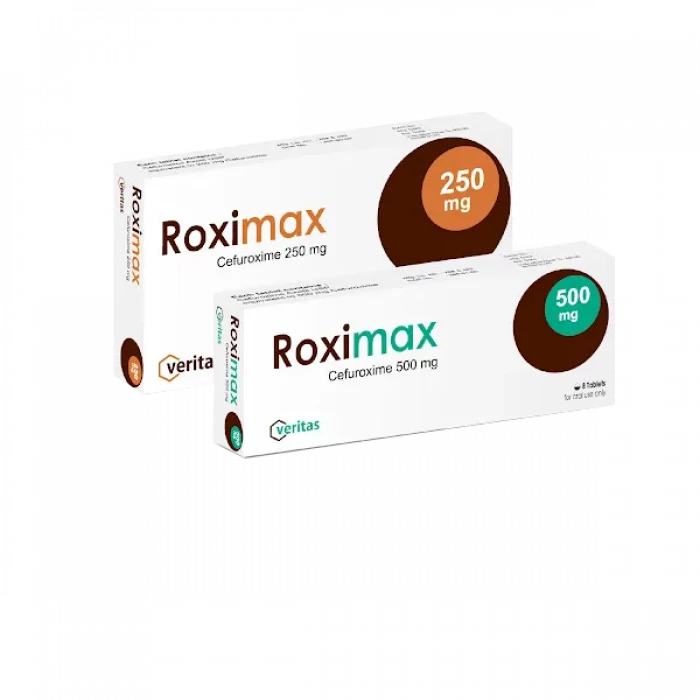
Price in Bangladesh
৳ 25.07 unit price
Price updated: 22 Nov 2026
- Strength
- 250 mg
About Roximax 250 mg Tablet
Made by Veritas Pharmaceuticals Ltd., Roximax is a tablet whose active ingredient is Cefuroxime Axetil. Pharyngitis/Tonsillitis caused by Streptococcus pyogenes.
There are 11 brands of Cefuroxime Axetil listed in Bangladesh. 4 of them have a lower unit price than Roximax. The lowest listed price is Axim 250 mg Tablet at ৳ 25.00 per unit.
What is Roximax 250 mg Tablet?
Roximax is a tablet from Veritas Pharmaceuticals Ltd., with the generic name Cefuroxime Axetil. Acute Bacterial Otitis Media caused by Streptococcus pneumoniae, Haemophilus influenzae, Moraxella catarrhalis (beta-lactamase producing strains) or Streptococcus pyogenes. Cefuroxime has good stability to bacterial β-lactamase and consequently, is active against many ampicillin-resistant and amoxycillin-resistant strains. The doctor decides the dose and course.
Uses of Roximax
Pharyngitis/Tonsillitis caused by Streptococcus pyogenes. Acute Bacterial Otitis Media caused by Streptococcus pneumoniae, Haemophilus influenzae, Moraxella catarrhalis (beta-lactamase producing strains) or Streptococcus pyogenes. Cefuroxime Axetil is indicated for the treatment of infections caused by sensitive bacteria. Your doctor will decide if it is suitable for you.
How to use Roximax
Roximax is taken by mouth. Swallow the tablet with water. Swallow the tablet as advised. Do not change the dose or stop early without asking your doctor. Complete the course exactly as prescribed.
Side effects of Roximax
Adverse effects to Cefuroxime have occurred infrequently and have been generally mild and transient in nature. As with other antibiotics, prolonged use may result in the overgrowth of non susceptible organisms e.g. Effects reported include rashes and gastrointestinal disturbances. Contact your doctor if you notice anything unusual after taking it. Tell your doctor if any side effect bothers you or does not go away.
Safety and precautions
US FDA pregnancy category of Cefuroxime is B. Cefuroxime has shown, that is not likely to be a problem at the recommended to dose levels. Cefuroxime is contraindicated in patients with known allergy to Cephalosporins. Ask your doctor first if any of these apply to you.
Frequently asked questions
What is Roximax used for?
Pharyngitis/Tonsillitis caused by Streptococcus pyogenes. Acute Bacterial Otitis Media caused by Streptococcus pneumoniae, Haemophilus influenzae, Moraxella catarrhalis (beta-lactamase producing strains) or Streptococcus pyogenes.
How do I use Roximax correctly?
Roximax is taken by mouth. Swallow the tablet with water.
What should I watch for while using Roximax?
Adverse effects to Cefuroxime have occurred infrequently and have been generally mild and transient in nature. As with other antibiotics, prolonged use may result in the overgrowth of non susceptible organisms e.g.
What is the price of Roximax?
The listed price is ৳ 25.07.
Indications
It is indicated for the treatment of infections caused by sensitive bacteria.
- Pharyngitis/Tonsillitis caused by Streptococcus pyogenes.
- Acute Bacterial Otitis Media caused by Streptococcus pneumoniae, Haemophilus influenzae, Moraxella catarrhalis (beta-lactamase producing strains) or Streptococcus pyogenes.
... Read more
It is indicated for the treatment of infections caused by sensitive bacteria.
- Pharyngitis/Tonsillitis caused by Streptococcus pyogenes.
- Acute Bacterial Otitis Media caused by Streptococcus pneumoniae, Haemophilus influenzae, Moraxella catarrhalis (beta-lactamase producing strains) or Streptococcus pyogenes.
- Acute bacterial maxillary sinusitis caused by Streptococcus pneumoniae or Haemophilus influenzae (non beta-lactamase producing strains)
- Lower respiratory tract infections including pneumoniae, caused by Streptococcus pneumoniae, Haemophilus influenzae (including beta lactamase-producing strains), Klebsiella spp., Staphylococcus aureus (penicillinase- and non-penicillinase-producing strains), Streptococcus pyogenes, E. coli
- Acute bacterial exacerbation of chronic bronchitis and Secondary bacterial infections of Acute bronchitis caused by Streptococcus pneumoniae, Haemophilus influenzae (beta-lactamase negative strains) or Haemophilus parainfluenzae (beta-lactamase negative strains).
- Skin and skin-structure infections caused by Staphylococcus aureus (including beta-lactamase producing strains) or Streptococcus pyogenes.
- Urinary tract infections caused by E.coli or Klebsiella pneumoniae.
- Bone and Joint Infections caused by Staphylococcus aureus (penicillinase- and non-penicillinase-producing strains).
- Gonorrhoea caused by penicillinase-producing and non-penicillinase producing strains of Neisseria gonorrhoeae.
- Early Lyme Disease (erythema migrans) caused by Borrelia burgdorferi.
Pharmacology
Cefuroxime is a well-characterized and effective antibacterial agent, which has broad-spectrum bactericidal activity against a wide range of common pathogens, including β-lactamase producing strains. Cefuroxime has good stability to bacterial β-lactamase and consequently, is active against many ampicillin-resistant and amoxycillin-resistant strains.
Dosage & Administration
Tablet or Suspension-
Adolescents and adults (13 years and older)-
- Pharyngitis/tonsillitis: 250 mg b.i.d. for 5-10 days
- Acute bacterial maxillary sinusitis: 250 mg b.i.d. for 10 days
- Acute bacterial exacerbation of chronic bronchitis: 250-500 mg b.i.d. for 10 days
- Secondary bacterial infections of acute bronchitis: 250-500 mg b.i.d. for 5-10 days
- Uncomplicated skin and skin structure infections: 250-500 mg b.i.d. for 10 days
- Uncomplicated urinary tract infections: 250 mg b.i.d. for 7-10 days
- Uncomplicated Gonorrhoea: 1000 mg Single dose
- Community acquired pneumonia: 250-500 mg b.i.d. for 5-10 days
- MDR Typhoid Fever: 500 mg b.i.d. for 10-14 days
- Early Lyme disease: 500 mg b.i.d. for 20 days
Paediatric Patients (3 months to 12 years)-
- Pharyngitis/Tonsillitis: 20 mg/kg/day b.i.d for 5-10 days
- Acute otitis media: 30 mg/kg/day b.i.d for 10 days
- Acute bacterial maxillary sinusitis: 30 mg/kg/day b.i.d for 10 days
- Impetigo: 30 mg/kg/day b.i.d for 10 days
Parenteral-
- Adult: 750 mg three times daily by IM or IV injection. In severe infections, dose can be increased upto 1.5 gm three times daily by IV injection. The frequency may be increased to four times daily, if necessary, giving total daily doses of 3 to 6 gms.
- Children (above 3 months of age): 30 - 100 mg/kg/day given in 3 or 4 equally divided doses. A dose of 60 mg/kg/day is appropriate for most infections.
- Neonate: 30 - 100 mg/kg/day given in 2 or 3 equally divided doses.
- Surgical prophylaxis: 1.5 gm by IV injection at induction of anaesthesia; up to 3 further doses of 750 mg may be given by IV/IM injection every 8 hours for high risk procedures.
- Pneumonia: 1.5 gm IV injection twice daily for 2-3 days, followed by 500 mg twice daily (oral) for 7-10 days.
Acute exacerbations of chronic bronchitis: 750 mg twice daily (IM or IV injection) for 2-3 days, followed by 500 mg twice daily (oral) for 5-10 days. (Duration of both parenteral and oral therapy is determined by the severity of the infection and the clinical status of the patient.)- In Gonorrhoea: Adult: 1.5 gm as a single dose (as 2 x 750mg injections intramuscularly with different sites, e.g. each buttock).
In Meningitis:
- Adult: 3 gm IV injection three times daily.
- Children (above 3 months of age): 200-240 mg/kg/day by IV injection in 3 or 4 divided doses reduced to 100 mg/kg/day after 3 days or on clinical improvement.
- Neonate: 100 mg/kg/day by IV injection at initial dose, reduced to 50 mg/kg/day, When clinically indicated.
In bone and joint infections:
- Adult: 1.5 gm IV injection four times daily.
- Children (above 3 months of age): 150 mg/kg/day (not to exceed the maximum adult dose) in equally divided doses every 8 hours.
Interaction
No potentially hazardous interactions have been reported.
Contraindications
Cefuroxime is contraindicated in patients with known allergy to Cephalosporins.
Side Effects
Adverse effects to Cefuroxime have occurred infrequently and have been generally mild and transient in nature. Effects reported include rashes and gastrointestinal disturbances. As with other antibiotics, prolonged use may result in the overgrowth of non susceptible organisms e.g. Candida.
Pregnancy & Lactation
US FDA pregnancy category of Cefuroxime is B. There are, however, no adequate and well-controlled studies in pregnant women. Because animal reproduction studies are not always predictive of human response, this drug should be used during pregnancy only if clearly needed. Cefuroxime have been shown to be excreted in human milk. So, caution should be exercised when Cefuroxime is administered to a nursing woman.
Precautions & Warnings
Cefuroxime should be given with care to patients receiving concurrent treatment with potent diuretics & who has history of colitis. Cephalosporin antibiotics may in general be given safely to patients who are hypersensitive to penicillin although cross reactions have reported. Cefuroxime has shown, that is not likely to be a problem at the recommended to dose levels.
Storage Conditions
Store in a cool, dry place (below 30o C), away from light & moisture. Keep out of the reach of children.
Medicine information is for reference only and is not medical advice. Always follow your doctor's prescription and check with a pharmacist.