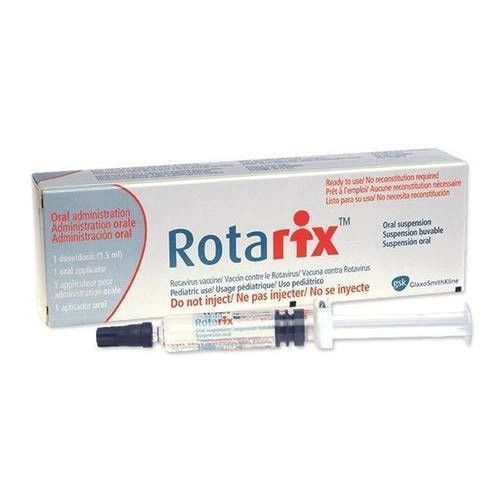
Price in Bangladesh
৳ 3999.00 unit price
Price updated: 22 Nov 2026
- Strength
- 1.5 ml/dose
About Rotarix 1.5 ml/dose Oral Suspension
Rotarix 1.5 ml/dose is a oral suspension product of GlaxoSmithKline that contains Rotavirus Vaccine. Rotarix contains Rotavirus Vaccine, which belongs to the Vaccines, Anti-sera & Immunoglobulin group of medicines.
What is Rotarix 1.5 ml/dose Oral Suspension?
Made by GlaxoSmithKline, Rotarix is a oral suspension whose active ingredient is Rotavirus Vaccine. Exact immunologic mechanism of action is not fully understood although it is known that vaccine viruses replicate in the small intestine and promote active immunity. Rotavirus is a live, attenuated monovalent vaccine derived from human strain indicated for prevention of rotavirus gastroenteritis caused by G1, G3, G4 and G9 serotypes; Rotavirus as a live. The doctor decides the dose and course.
Uses of Rotarix
Rotarix contains Rotavirus Vaccine, which belongs to the Vaccines, Anti-sera & Immunoglobulin group of medicines. Your doctor will decide if it is suitable for you.
How to use Rotarix
Shake the bottle well before each use. Measure the liquid with the spoon or cap that comes with the pack. Do not take more than the doctor advises. Do not change the dose or stop early without asking your doctor. If you miss a dose, ask your doctor or pharmacist what to do.
Side effects of Rotarix
Very common areirritability, loss of appetite; common arediarrhoea, vomiting, flatulence, abdominal pain, regurgitation of food, fever, fatigue; uncommon are- crying, sleep disorder, somnolence, constipation rare. In controlled clinical studies, the adverse reaction profile observed in the subjects receiving Rotavirus Vaccine was similar to the adverse reaction profile observed in subjects receiving placebo. In a large safety trial, subjects vaccinated with Rotavirus Vaccine gave evidence of no increased risk of intussusception when compared with subjects receiving a placebo. Contact your doctor if you notice anything unusual after taking it. Tell your doctor if any side effect bothers you or does not go away.
Safety and precautions
Animal reproduction studies have shown an adverse effect on the fetus and there are no adequate and well-controlled studies in humans, but potential benefits may warrant use of the drug in pregnant women despite potential risks Rotavirus Vaccine should be administered with caution to infants with close contacts who are immunodeficient, such as household members with malignancies or who are otherwise immunocompromised or receiving immunosuppressive therapy. Contacts of recent vaccinees should be advised to observe personal hygiene Ask your doctor first if any of these apply to you.
Frequently asked questions
What does Rotarix treat?
Rotarix contains Rotavirus Vaccine, which belongs to the Vaccines, Anti-sera & Immunoglobulin group of medicines. Your doctor will decide if it is suitable for you.
How do I use Rotarix correctly?
Shake the bottle well before each use. Measure the liquid with the spoon or cap that comes with the pack.
What should I watch for while using Rotarix?
Very common areirritability, loss of appetite; common arediarrhoea, vomiting, flatulence, abdominal pain, regurgitation of food, fever, fatigue; uncommon are- crying, sleep disorder, somnolence, constipation rare. In controlled clinical studies, the adverse reaction profile observed in the subjects receiving Rotavirus Vaccine was similar to the adverse reaction profile observed in subjects receiving placebo.
How much does Rotarix cost in Bangladesh?
The listed price is ৳ 3999.00.
Indications
Rotavirus vaccine is indicated for the prevention of rotavirus gastroenteritis in infants and children caused by Types G1, G2, G3, G4, and G9 when administered as a 3-dose series to infants between the ages of 6 to 32 weeks. The first dose of Rotavirus vaccine should be administered between 6 and 12 ... Read moreRotavirus vaccine is indicated for the prevention of rotavirus gastroenteritis in infants and children caused by Types G1, G2, G3, G4, and G9 when administered as a 3-dose series to infants between the ages of 6 to 32 weeks. The first dose of Rotavirus vaccine should be administered between 6 and 12 weeks of age.
The vaccination series consists of 3 ready-to-use liquid doses of Rotavirus vaccine administered orally starting at 6 to 12 weeks of age, with the subsequent doses administered at 4- to 10-week intervals. The third dose should not be given after 32 weeks of age.
Pharmacology
Rotavirus is one of the important causes of severe acute gastroenteritis in infants and young children. There are 2 commercially available forms of rotavirus vaccine. Rotavirus is a live, attenuated monovalent vaccine derived from human strain indicated for prevention of rotavirus gastroenteritis caused by G1, G3, G4 and G9 serotypes; Rotavirus as a live, pentavalent human-bovine reassortant vaccine indicated for prevention of gastreoenteritis caused by rotavirus serotypes G1, G2, G3 and G4. Although presence of porcine cirovirus (PCV1 and PCV2) DNA have been detected in the rotavirus vaccine, current available information shows that there is no evidence that PCV1 or PCV2 poses a safety risk to humans. Exact immunologic mechanism of action is not fully understood although it is known that vaccine viruses replicate in the small intestine and promote active immunity.
Dosage & Administration
The vaccination course consists of two doses. The first dose may be administered from the age of 6 weeks. There should be an interval of at least 4 weeks between the dosages. The vaccination course should be completed by the age of 24 weeks. Lyophilised vaccine to be recostituted with a liquid diluent before oral administration. After reconstitution, 1 dose (1 ml) contains- live attenuated human rotavirus RIX4414 strain not less than 106 CCID50. Repeat dosing is not indicated if an infant should spit out, regurgitate or vomit during or after the administration of the vaccine. The vaccination course should be completed as recommended above. There are no restrictions on the infant's consumption of food or liquid, including breast-milk, either before or after vaccination.
Interaction
Rotavirus vaccine can be given concomitantly with any of the following administered either as monovalent or as combination vaccines: Diphtheria-tetanus-whole cell pertussis vaccine (DTPw), Diphtheria-tetanus-acellular pertussis vaccine (DTPa), Haemophilus influenzae type b vaccine (Hib). inactivated Polio vaccine (IPV), Hepatitis B vaccine and Pneumococcal vaccine.
Concomitant administration of Rotavirus vaccine and oral polio vaccine (OPV) does not affect the immune response to the polio antigens. Although concomitant administration of OPV may slightly reduce the immune response to rota virus vaccine there is currently no evidence that clinical protection against severe rotavirus gastroenteritis would be affected. The immune response to Rotavirus vaccine is unaffected when OPV is administered two weeks apart from Rotavirus vaccine. Effects on ability to drive and use machines- not applicable.
Contraindications
Subjects with history of intussusception. Subjects with Severe Combined Immunodeficiency (SCID) disorder The presence of a minor infection, such as a cold, is not a contraindication for immunisation.
Side Effects
In controlled clinical studies, the adverse reaction profile observed in the subjects receiving Rotavirus vaccine was similar to the adverse reaction profile observed in subjects receiving placebo. No increase in the incidence or severity of these reactions was seen with the second dose.
However, some adverse reactions considered as being at least possibly related to Rotavirus vaccine vaccination were reported. Very common areirritability, loss of appetite; common arediarrhoea, vomiting, flatulence, abdominal pain, regurgitation of food, fever, fatigue; uncommon are- crying, sleep disorder, somnolence, constipation rare; upper respiratory tract infection hoarseness, rhinorrhoea, dermatitis, rash, muscle cramp; very rare- gastro-enteritis. In a large safety trial, subjects vaccinated with Rotavirus vaccine gave evidence of no increased risk of intussusception when compared with subjects receiving a placebo.
Pregnancy & Lactation
Pregnancy Category C. Animal reproduction studies have shown an adverse effect on the fetus and there are no adequate and well-controlled studies in humans, but potential benefits may warrant use of the drug in pregnant women despite potential risks
Precautions & Warnings
It is good clinical practice that vaccination should be preceded by a review of the medical history (especially with regard to previous vaccination and possible occurrence of undesirable events) and a clinical examination. Parents/ guardians should be advised to seek medical advice promptly where these signs/symptoms are evident. There is a potential risk for transmission to non-vaccinated contacts. It should be administered with caution to infants with close contacts who are immunodeficient, such as household members with malignancies or who are otherwise immunocompromised or receiving immunosuppressive therapy. Contacts of recent vaccinees should be advised to observe personal hygiene
Storage Conditions
Store refrigerated at 2° to 8°C. Protect vials from light.
Medicine information is for reference only and is not medical advice. Always follow your doctor's prescription and check with a pharmacist.