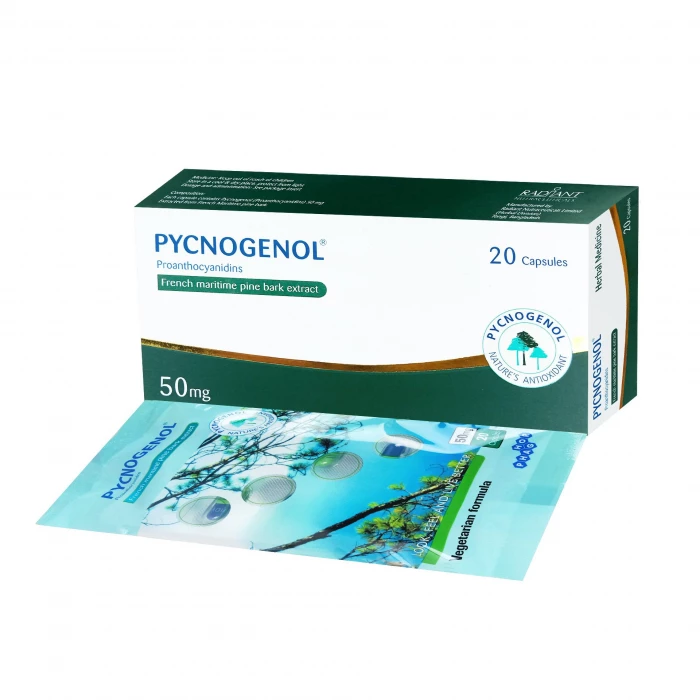
Price in Bangladesh
৳ 50.00 unit price
Price updated: 22 Nov 2026
- Strength
- 50 mg
About Pycnogenol 50 mg Capsule
Pycnogenol is a capsule from Radiant Nutraceuticals Ltd., with the generic name Proanthocyanidins. Chronic venous insufficiency (edema), thrombosis (blood clot), diabetes and its complications, retinopathy, hypertension (high blood pressure) and its complications, allergy, asthma.
What is Pycnogenol 50 mg Capsule?
Pycnogenol 50 mg capsule is a medicine made by Radiant Nutraceuticals Ltd. Proanthocyanidins prevents the oxidation of LDL cholesterol, protects the DNA from free-radical damage, prevents stress-related blood clotting without increasing bleeding risk. Recent research suggests significant antioxidant activity is primarily based on its proanthocyanidin content. Whether it suits you is a decision for your doctor.
Uses of Pycnogenol
Chronic venous insufficiency (edema), thrombosis (blood clot), diabetes and its complications, retinopathy, hypertension (high blood pressure) and its complications, allergy, asthma. Your doctor will decide if it is suitable for you.
How to use Pycnogenol
Pycnogenol is taken by mouth. Swallow the capsule whole with water. Take Pycnogenol exactly as prescribed by your doctor. Do not change the dose or stop early without asking your doctor. Complete the course exactly as prescribed.
Side effects of Pycnogenol
Minor adverse effects including headache and dizziness may occur. No serious side effects have been reported. To avoid gastric upset, diarrhea & constipation, Proanthocyanidins should be taken with meals. Tell your doctor if any side effect bothers you or does not go away. Contact your doctor if you notice anything unusual after taking it.
Safety and precautions
There are no known contraindications for Proanthocyanidins. Safety trials have demonstrated absence of mutagenic and teratogenic effects, no perinatal toxicity, and no negative effects on fertility. Tell your doctor about all the other medicines you take.
Frequently asked questions
What is Pycnogenol used for?
Chronic venous insufficiency (edema), thrombosis (blood clot), diabetes and its complications, retinopathy, hypertension (high blood pressure) and its complications, allergy, asthma. Your doctor will decide if it is suitable for you.
How is Pycnogenol used?
Pycnogenol is taken by mouth. Swallow the capsule whole with water.
What should I watch for while using Pycnogenol?
Minor adverse effects including headache and dizziness may occur. No serious side effects have been reported.
How much does Pycnogenol cost in Bangladesh?
The listed price is ৳ 50.00.
Indications
Chronic venous insufficiency (edema), thrombosis (blood clot), diabetes and its complications, retinopathy, hypertension (high blood pressure) and its complications, allergy, asthma, endometriosis (premenstrual pain caused by endometrial tissue in places other than the uterus) and dysmenorrhea (painful menstruation), osteoarthritis, skin disorders & melasma (a dark pigmentation of the skin).
Pharmacology
French maritime pine bark extract is made by extraction of the outer bark of Pinus pinaster. Recent research suggests significant antioxidant activity is primarily based on its proanthocyanidin content. Proanthocyanidins prevents the oxidation of LDL cholesterol, protects the DNA from free-radical damage, prevents stress-related blood clotting without increasing bleeding risk, increases nitric oxide synthesis leading to vasodilation, has profound anti-inflammatory activity, protects the skin from sun damage, dramatically improves wound healing while decreasing scarring, boosts many aspects of immune system function, and also lowers blood sugar while stimulating fat tissue breakdown.
Dosage & Administration
Generally, one capsule (50 mg) 2 times daily with meals for 2-3 months or as directed by the physician. A repeated course or long-term use is acceptable.
- Hypertension, blood hyper-coagulation, impaired circulation: 50 mg twice daily
- Diabetes: 50 mg twice daily
- Retinopathy: 50 mg twice or thrice daily
- Asthma: 1 mg/lb of body weight/day in two divided doses or 50 mg twice daily
- Allergies: 50 mg twice daily
- As an anti-inflammatory agent: 50 mg once or twice daily
- Osteoarthritis: 50 mg twice daily
- Dysmenorrhea/Endometriosis: 50 mg once or twice daily
- Skin disorders/Melasma: 50 mg once or twice daily
- Edema in venous insufficiency: 50 mg once daily minimum 2–4 weeks (For more advanced stages the daily dosage should be higher, 50 mg twice or thrice daily for 4 weeks). Once edema and symptoms have improved, a daily maintenance dosage of 50 mg may be considered.
- As an antioxidant: 50 mg once daily
Interaction
There is no reported information of drug interaction resulting from simultaneous intake of Proanthocyanidins with other drugs.
Contraindications
There are no known contraindications for Proanthocyanidins.
Side Effects
No serious side effects have been reported. To avoid gastric upset, diarrhea & constipation, Proanthocyanidins should be taken with meals. Minor adverse effects including headache and dizziness may occur.
Pregnancy & Lactation
As a general precaution, pregnant women should not take Proanthocyanidins within the first 3 months of pregnancy. Safety trials have demonstrated absence of mutagenic and teratogenic effects, no perinatal toxicity, and no negative effects on fertility. There are no adequate and well-controlled studies of Proanthocyanidins in children under the age of 6 years.
Storage Conditions
Store in a cool and dry place, protect from light. Do not use the drug after expiry date. Keep out of reach of children.
Medicine information is for reference only and is not medical advice. Always follow your doctor's prescription and check with a pharmacist.