Price in Bangladesh
৳ 100.00 unit price
Price updated: 22 Nov 2026
- Strength
- 20 mg/ml
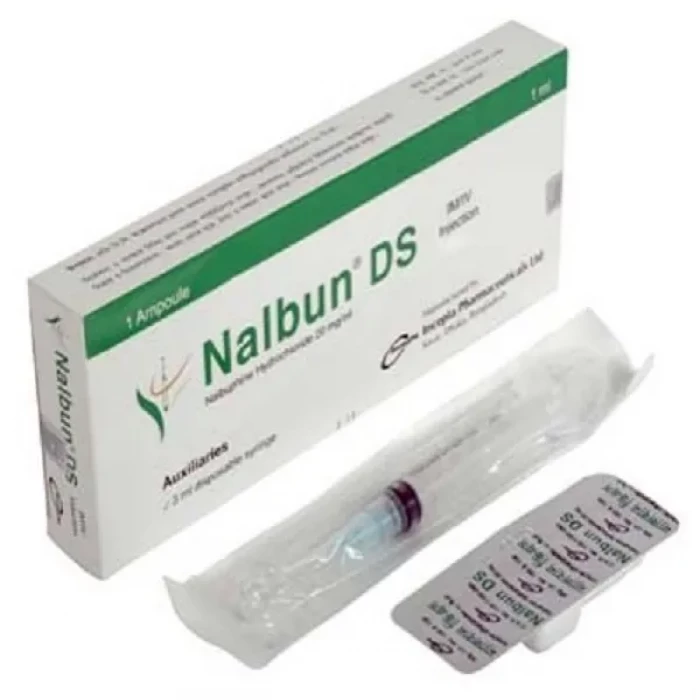
About Nalbun DS 20 mg/ml IM/IV Injection
The im/iv injection Nalbun DS contains Nalbuphine and is made by Incepta Pharmaceuticals Ltd. Nalbuphine Hydrochloride can also be used as a supplement to balanced anesthesia, for preoperative and postoperative analgesia, and for obstetrical analgesia during labor and delivery.
There are 2 brands of Nalbuphine listed in Bangladesh. By unit price, Nalbun DS is among the cheapest of them.
What is Nalbun DS 20 mg/ml IM/IV Injection?
Made by Incepta Pharmaceuticals Ltd., Nalbun DS is a im/iv injection whose active ingredient is Nalbuphine. Its analgesic potency is essentially equivalent to that of morphine on a milligram basis. Nalbuphine is primarily a kappa agonist/partial mu antagonist analgesic. Ask your doctor or pharmacist if you are unsure about it.
Uses of Nalbun DS
Nalbuphine Hydrochloride can also be used as a supplement to balanced anesthesia, for preoperative and postoperative analgesia, and for obstetrical analgesia during labor and delivery. Nalbuphine Hydrochloride is indicated for the relief of moderate to severe pain. Your doctor will decide if it is suitable for you.
How to use Nalbun DS
Nalbun DS is given as an injection by a healthcare professional. Do not inject it yourself unless a doctor has shown you how. If you are unsure how to take it, ask your doctor or pharmacist. Complete the course exactly as prescribed. Do not change the dose or stop early without asking your doctor.
Side effects of Nalbun DS
Tell your doctor if any side effect bothers you or does not go away. Contact your doctor if you notice anything unusual after taking it.
Safety and precautions
There are no well-controlled studies in pregnant women. Caution should be exercised when Nalbuphine is administered to a nursing woman. Known hypersensitivity to Nalbuphine Hydrochloride. Keep out of reach of children.
Frequently asked questions
What is Nalbun DS used for?
Nalbuphine Hydrochloride can also be used as a supplement to balanced anesthesia, for preoperative and postoperative analgesia, and for obstetrical analgesia during labor and delivery. Nalbuphine Hydrochloride is indicated for the relief of moderate to severe pain.
How should I take Nalbun DS?
Nalbun DS is given as an injection by a healthcare professional. Do not inject it yourself unless a doctor has shown you how.
What are the side effects of Nalbun DS?
Tell your doctor if any side effect bothers you or does not go away. Contact your doctor if you notice anything unusual after taking it.
What is the price of Nalbun DS?
The listed price is ৳ 100.00.
Indications
Nalbuphine Hydrochloride is indicated for the relief of moderate to severe pain. It is used for relief of moderate to severe pain associated with myocardial infarction (MI). Nalbuphine Hydrochloride can also be used as a supplement to balanced anesthesia, for preoperative and postoperative analgesia, and for obstetrical analgesia during labor and delivery.
Pharmacology
Nalbuphine Hydrochloride is a synthetic potent analgesic. Its analgesic potency is essentially equivalent to that of morphine on a milligram basis. Receptor studies show that Nalbuphine binds to mu, kappa, and delta receptors, but not to sigma receptors. Nalbuphine is primarily a kappa agonist/partial mu antagonist analgesic.
Dosage & Administration
The usual recommended adult dose is 10 mg for a 70 kg individual, administered subcutaneously, intramuscularly or intravenously; this dose may be repeated every 3 to 6 hours as necessary. Dosage should be adjusted according to the severity of the pain, physical status of the patient, and other medications which the patient may be
receiving.
Moderate to severe pain: by intravenous or intramuscular injection 10-20 mg for 70 kg patient, adjusted as required; child up to 0.3 mg/kg repeated once or twice as necessary.
Preoperative anesthesia: by intravenous or intramuscular injection 0.1-0.2 mg/kg.
Obstetrical analgesia during labor & delivery: by intravenous injection 0.3-1 mg/kg over 10-15 minutes with maintenance doses of 0.25-0.5 mg/kg in single intravenous administration as required.
Intraoperative analgesia: by intravenous injection 0.25-0.5 mg/kg at 30 minutes intervals.
Myocardial infarction: By slow intravenous injection 10-20 mg, repeated after 30 minutes if necessary. Larger dose is required when used as supplement of anesthesia than that required for analgesia.
Children from 18 months to 15 years old: usually 0.2 mg/ kg body-weight, given preferably by intravenous or intramuscular injection. Maintenance doses may be given at intervals of 4 to 6 hours or the dose must be determined by the physician.
Interaction
No hazardous interactions have been identified with Nalbuphine; however, interactions described with other opioids may be anticipated. Patient receiving a narcotic analgesic, general anesthesia, phenothiazines or other tranquilizers, sedatives, hypnotics, or other CNS depressants (including alcohol) concomitantly with Nalbuphine may exhibit an additive effect.
Contraindications
Known hypersensitivity to Nalbuphine Hydrochloride.
Side Effects
Generally Nalbuphine is well tolerated. However few side-effects like sedation, sweating, nausea, vomiting, dizziness, vertigo, dry mouth, headache, respiratory depression, dyspnea and asthma may be seen.
Pregnancy & Lactation
Pregnancy category B. The placental transfer of Nalbuphine is high and rapid. There are no well-controlled studies in pregnant women. This drug should be used during pregnancy only if clearly needed. Limited data suggest that Nalbuphine is excreted in maternal milk but only in a small amount (less than 1% of the administered dose) and with a clinically insignificant effect. Caution should be exercised when Nalbuphine is administered to a nursing woman.
Precautions & Warnings
Caution should be taken in the following conditions: impaired respiration, impaired renal or hepatic function, billiary tract surgery, myocardial infarction and hypotension.
Overdose Effects
Sleepiness & mild dyspnea may occur due to overdose. The immediate intravenous administration of an opiate antagonist such as Naloxone or Nalmefene is a specific antidote. Oxygen, intravenous fluids, vasopressors and other supportive measures should be used as indicated
Storage Conditions
Keep it in a cool and dry place, protected from light and moisture.
Medicine information is for reference only and is not medical advice. Always follow your doctor's prescription and check with a pharmacist.