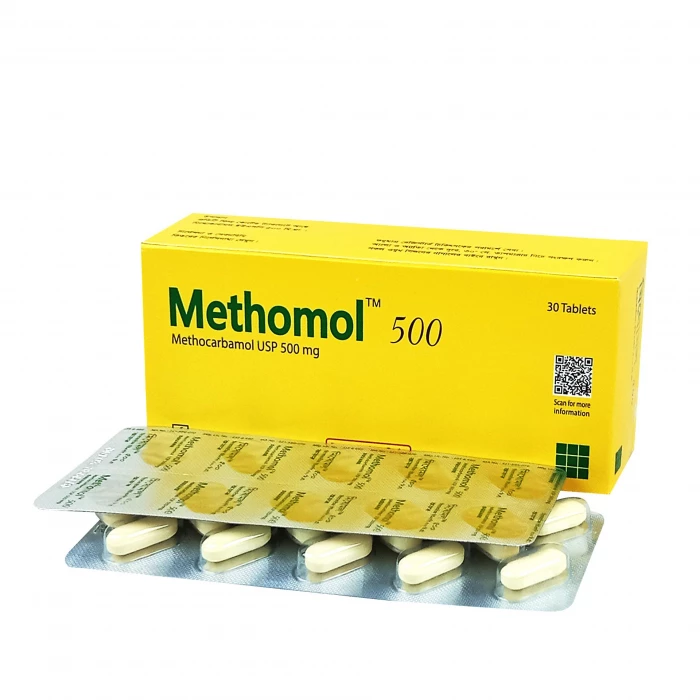
Price in Bangladesh
৳ 10.00 unit price
Price updated: 22 Nov 2026
- Strength
- 500 mg
About Methomol 500 mg Tablet
The tablet Methomol contains Methocarbamol and is made by Square Pharmaceuticals PLC. Methocarbamol is indicated as an adjunct to rest, physical therapy, and other measures for the relief of discomfort associated with acute, painful musculoskeletal conditions.
There are 2 brands of Methocarbamol listed in Bangladesh. By unit price, Methomol is among the cheapest of them.
What is Methomol 500 mg Tablet?
Methomol is a tablet from Square Pharmaceuticals PLC., with the generic name Methocarbamol. It has no direct relaxant effects on striated muscle, nerve fibers, or the motor endplate. The drug has a secondary sedative effect. Ask your doctor or pharmacist if you are unsure about it.
Uses of Methomol
Methocarbamol is indicated as an adjunct to rest, physical therapy, and other measures for the relief of discomfort associated with acute, painful musculoskeletal conditions. Methocarbamol does not directly relax tense skeletal muscles in man The mode of action of Methocarbamol has not been clearly identified, but may be related to its sedative properties. Your doctor will decide if it is suitable for you.
How to use Methomol
Swallow the tablet with water. Methomol is taken by mouth. Shake the bottle well before each use. Do not change the dose or stop early without asking your doctor. If you miss a dose, ask your doctor or pharmacist what to do.
Side effects of Methomol
Contact your doctor if you notice anything unusual after taking it. Tell your doctor if any side effect bothers you or does not go away.
Safety and precautions
There have been reports of fetal and congenital abnormalities following in utero exposure to Methocarbamol. Methocarbamol is contraindicated in patients hypersensitive to Methocarbamol or to any of the tablet components. Tell your doctor about all the other medicines you take.
Frequently asked questions
Why is Methomol prescribed?
Methocarbamol is indicated as an adjunct to rest, physical therapy, and other measures for the relief of discomfort associated with acute, painful musculoskeletal conditions. Methocarbamol does not directly relax tense skeletal muscles in man The mode of action of Methocarbamol has not been clearly identified, but may be related to its sedative properties.
How should I take Methomol?
Swallow the tablet with water. Methomol is taken by mouth.
What are the side effects of Methomol?
Contact your doctor if you notice anything unusual after taking it. Tell your doctor if any side effect bothers you or does not go away.
What is the price of Methomol?
The listed price is ৳ 10.00.
Indications
Methocarbamol is indicated as an adjunct to rest, physical therapy, and other measures for the relief of discomfort associated with acute, painful musculoskeletal conditions. The mode of action of methocarbamol has not been clearly identified, but may be related to its sedative properties. Methocarbamol does not directly relax tense skeletal muscles in man
Pharmacology
Methocarbamol is a central muscle relaxant for skeletal muscles, used to treat spasms. It is structurally related to guaifenesin. Methocarbamol's exact mechanism of causing skeletal muscle relaxation is unknown. It is thought to work centrally, perhaps by general depressant effects. It has no direct relaxant effects on striated muscle, nerve fibers, or the motor endplate. It will not directly relax contracted skeletal muscles. The drug has a secondary sedative effect.
The mechanism of action of methocarbamol in humans has not been established, but may be due to general central nervous system (CNS) depression. It has no direct action on the contractile mechanism of striated muscle, the motor end plate or the nerve fiber.
Dosage & Administration
Methocarbamol 500 mg:
- Initial dosage: 1500 mg (3 tablets) q.i.d.
- Maintenance dosage: 2 tablets q.i.d.
Methocarbamol 750 mg:
- Initial dosage: 1500 mg (2 tablets) q.i.d.
- Maintenance dosage: 1 tablet q.4h. or 2 tablets t.i.d.
Six grams a day are recommended for the first 48 to 72 hours of treatment. (For severe conditions 8 grams a day may be administered). Thereafter, the dosage can usually be reduced to approximately 4 grams a day.
Interaction
Methocarbamol may inhibit the effect of pyridostigmine bromide. Therefore, methocarbamol should be used with caution in patients with myasthenia gravis receiving anticholinesterase agents.
Contraindications
Methocarbamol is contraindicated in patients hypersensitive to methocarbamol or to any of the tablet components.
Side Effects
Body as a whole: Anaphylactic reaction, angioneurotic edema, fever, headache
Cardiovascular system: Bradycardia, flushing, hypotension, syncope, thrombophlebitis
Digestive system: Dyspepsia, jaundice (including cholestatic jaundice), nausea and vomiting
Hemic and lymphatic system: Leukopenia
Immune system: Hypersensitivity reactions
Nervous system: Amnesia, confusion, diplopia, dizziness or lightheadedness, drowsiness, insomnia, mild muscular incoordination, nystagmus, sedation, seizures (including grand mal), vertigo
Skin and special senses: Blurred vision, conjunctivitis, nasal congestion, metallic taste, pruritus, rash, urticaria
Pregnancy & Lactation
Pregnancy Category C. Animal reproduction studies have not been conducted with methocarbamol. It is also not known whether methocarbamol can cause fetal harm when administered to a pregnant woman or can affect reproduction capacity. methocarbamol should be given to a pregnant woman only if clearly needed.
Safe use of methocarbamol has not been established with regard to possible adverse effects upon fetal development. There have been reports of fetal and congenital abnormalities following in utero exposure to methocarbamol. Therefore, methocarbamol should not be used in women who are or may become pregnant and particularly during early pregnancy unless in the judgment of the physician the potential benefits outweigh the possible hazards
Nursing Mothers: Methocarbamol and/or its metabolites are excreted in the milk of dogs; however, it is not known whether methocarbamol or its metabolites are excreted in human milk. Because many drugs are excreted in human milk, caution should be exercised when Methocarbamol is administered to a nursing woman.
Precautions & Warnings
Patients should be cautioned that methocarbamol may cause drowsiness or dizziness, which may impair their ability to operate motor vehicles or machinery. Because methocarbamol may possess a general CNS-depressant effect, patients should be cautioned about combined effects with alcohol and other CNS depressants.
Since methocarbamol may possess a general CNS depressant effect, patients receiving methocarbamol should be cautioned about combined effects with alcohol and other CNS depressants. Safe use of methocarbamol has not been established with regard to possible adverse effects upon fetal development. There have been reports of fetal and congenital abnormalities following in utero exposure to methocarbamol. Therefore, methocarbamol should not be used in women who are or may become pregnant and particularly during early pregnancy unless in the judgment of the physician the potential benefits outweigh the possible hazards
Overdose Effects
Limited information is available on the acute toxicity of methocarbamol. Overdose of methocarbamol is frequently in conjunction with alcohol or other CNS depressants and includes the following symptoms: nausea, drowsiness, blurred vision, hypotension, seizures, and coma. In post-marketing experience, deaths have been reported with an overdose of methocarbamol alone or in the presence of other CNS depressants, alcohol or psychotropic drugs.
Management of overdose includes symptomatic and supportive treatment. Supportive measures include maintenance of an adequate airway, monitoring urinary output and vital signs, and administration of intravenous fluids if necessary. The usefulness of hemodialysis in managing overdose is unknown.
Storage Conditions
Store at controlled room temperature, between 20°C and 25°C
Medicine information is for reference only and is not medical advice. Always follow your doctor's prescription and check with a pharmacist.