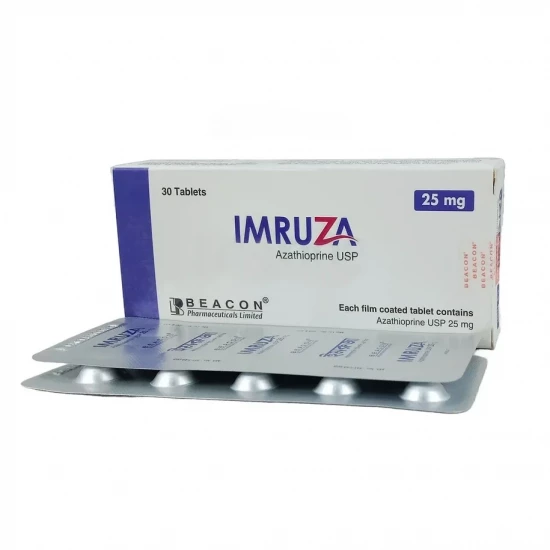
Price in Bangladesh
৳ 12.00 unit price
Price updated: 22 Nov 2026
- Strength
- 25 mg
About Imruza 25 mg Tablet
Imruza is a tablet from Beacon Pharmaceuticals PLC, with the generic name Azathioprine. Aspirin, non-steroidal anti-inflammatory drugs and/or low dose glucocorticoids may be continued during treatment with Azathioprine.
There are 3 brands of Azathioprine listed in Bangladesh. By unit price, Imruza is among the cheapest of them.
What is Imruza 25 mg Tablet?
Made by Beacon Pharmaceuticals PLC, Imruza is a tablet whose active ingredient is Azathioprine. Azathioprine is indicated as an adjunct for the prevention of rejection in renal homotransplantation. Ask your doctor or pharmacist if you are unsure about it.
Uses of Imruza
Aspirin, non-steroidal anti-inflammatory drugs and/or low dose glucocorticoids may be continued during treatment with Azathioprine. The use of Azathioprine with these agents cannot be recommended. Azathioprine is indicated as an adjunct for the prevention of rejection in renal homotransplantation. Your doctor will decide if it is suitable for you.
How to use Imruza
Imruza is taken by mouth. Swallow the tablet with water. If you miss a dose, ask your doctor or pharmacist what to do. Do not change the dose or stop early without asking your doctor.
Side effects of Imruza
Opportunistic infections especially in transplant patients receiving concomitant other immunosuppressants. Bone marrow depression, leucopenia, thrombocytopenia, nausea. Uncommonly, anaemia, hypersensitivity reactions, cholestasis, pancreatitis. Contact your doctor if you notice anything unusual after taking it. Tell your doctor if any side effect bothers you or does not go away.
Safety and precautions
There is positive evidence of human foetal risk, but the benefits from use in pregnant women may be acceptable despite the risk Inherited deficiency of thiopurine methyltransferase enzyme. Tell your doctor about all the other medicines you take.
Frequently asked questions
Why is Imruza prescribed?
Aspirin, non-steroidal anti-inflammatory drugs and/or low dose glucocorticoids may be continued during treatment with Azathioprine. The use of Azathioprine with these agents cannot be recommended.
How should I take Imruza?
Imruza is taken by mouth. Swallow the tablet with water.
Can Imruza cause side effects?
Opportunistic infections especially in transplant patients receiving concomitant other immunosuppressants. Bone marrow depression, leucopenia, thrombocytopenia, nausea.
What is the price of Imruza?
The listed price is ৳ 12.00.
Indications
Azathioprine is indicated as an adjunct for the prevention of rejection in renal homotransplantation. It is also indicated for the management of active rheumatoid arthritis to reduce signs and symptoms.
Renal Homotransplantation: Azathioprine is indicated as an ... Read moreAzathioprine is indicated as an adjunct for the prevention of rejection in renal homotransplantation. It is also indicated for the management of active rheumatoid arthritis to reduce signs and symptoms.
Renal Homotransplantation: Azathioprine is indicated as an adjunct for the prevention of rejection in renal homotransplantation. Experience with over 16,000 transplants shows a 5-year patient survival of 35% to 55%, but this is dependent on donor, match for HLA antigens, anti-donor or anti-B-cell alloantigen antibody, and other variables. The effect of Azathioprine on these variables has not been tested in controlled trials.
Rheumatoid Arthritis: Azathioprine is indicated for the treatment of active rheumatoid arthritis (RA) to reduce signs and symptoms. Aspirin, non-steroidal anti-inflammatory drugs and/or low dose glucocorticoids may be continued during treatment with Azathioprine. The combined use of Azathioprine with disease modifying anti-rheumatic drugs (DMARDs) has not been studied for either added benefit or unexpected adverse effects. The use of Azathioprine with these agents cannot be recommended.
Pharmacology
Azathioprine antagonizes purine metabolism and may inhibit synthesis of DNA, RNA, and proteins. It may also interfere with cellular metabolism and inhibit mitosis. Its mechanism of action is likely due to incorporation of thiopurine analogues into the DNA structure, causing chain termination and cytotoxicity.
Dosage & Administration
Renal Homotransplantation: The dose of Azathioprine required to prevent rejection and minimize toxicity will vary with individual patients; this necessitates careful management. The initial dose is usually 3 to 5 mg/kg daily, beginning at the time of transplant. Azathioprine is usually given as a single daily dose on the day of, and in a minority of cases 1 to 3 days before, transplantation. Dose reduction to maintenance levels of 1 to 3 mg/kg daily is usually possible. The dose of Azathioprine should not be increased to toxic levels because of threatened rejection. Discontinuation may be necessary for severe hematologic or other toxicity, even if rejection of the homograft may be a consequence of drug withdrawal.
Rheumatoid Arthritis: Azathioprine is usually given on a daily basis. The initial dose should be approximately 1.0 mg/kg (50 to 100 mg) given as a single dose or on a twice-daily schedule. The dose may be increased, beginning at 6 to 8 weeks and thereafter by steps at 4-week intervals, if there are no serious toxicities and if initial response is unsatisfactory. Dose increments should be 0.5 mg/kg daily, up to a maximum dose of 2.5 mg/kg per day. Therapeutic response occurs after several weeks of treatment, usually 6 to 8; an adequate trial should be a minimum of 12 weeks. Patients not improved after 12 weeks can be considered refractory. Azathioprine may be continued long-term in patients with clinical response, but patients should be monitored carefully, and gradual dosage reduction should be attempted to reduce risk of toxicities.
Maintenance therapy should be at the lowest effective dose, and the dose given can be lowered decrementally with changes of 0.5 mg/kg or approximately 25 mg daily every 4 weeks while other therapy is kept constant. The optimum duration of maintenance Azathioprine has not been determined. Azathioprine can be discontinued abruptly, but delayed effects are possible.
Interaction
Metabolism inhibited by allopurinol. Reduces the neuromuscular blockade of curare, tubocurarine but potentiates that of succinylcholine.
Contraindications
Azathioprine should not be used for treating rheumatoid arthritis in pregnant women.Patients with rheumatoid arthritis previously treated with alkylating agents (cyclophosphamide, chlorambucil, melphalan, or others) may have a prohibitive risk of malignancy if treated with Azathioprine
Side Effects
Opportunistic infections especially in transplant patients receiving concomitant other immunosuppressants. Bone marrow depression, leucopenia, thrombocytopenia, nausea. Uncommonly, anaemia, hypersensitivity reactions, cholestasis, pancreatitis.
Pregnancy & Lactation
Pregnancy Category D. There is positive evidence of human foetal risk, but the benefits from use in pregnant women may be acceptable despite the risk
Precautions & Warnings
Monitor FBC wkly during 1st 8 wk of therapy especially with high dose or severe renal/hepatic impairment. Inherited deficiency of thiopurine methyltransferase enzyme. Avoid excessive sun/UV exposure.
Storage Conditions
Azathioprine should be stored at 15 to 25° C in a dry place and protected from light.
Medicine information is for reference only and is not medical advice. Always follow your doctor's prescription and check with a pharmacist.