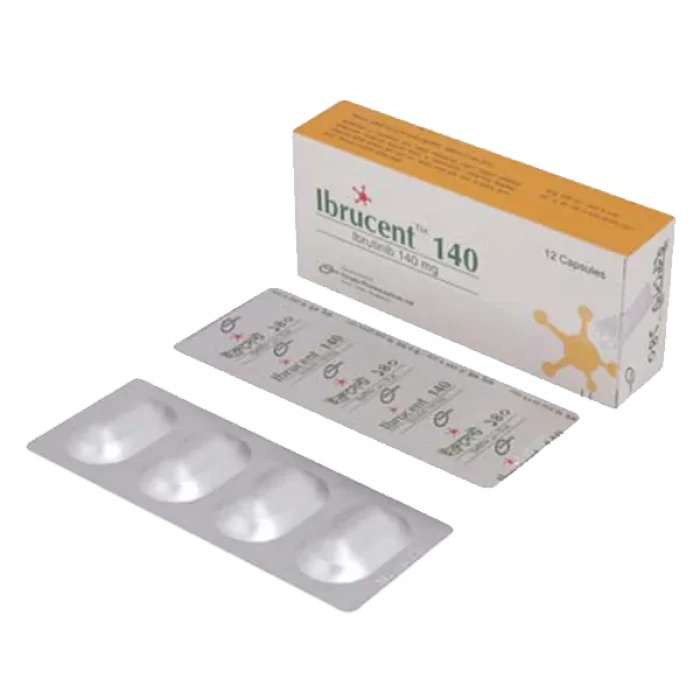
Price in Bangladesh
৳ 500.00 unit price
Price updated: 22 Nov 2026
- Strength
- 140 mg
About Ibrucent 140 mg Capsule
Ibrucent 140 mg capsule is a medicine made by Incepta Pharmaceuticals Ltd. Chronic Lymphocytic Leukemia/Small Lymphocytic Lymphoma : Ibrutinib is indicated for the treatment of patients.
There are 3 brands of Ibrutinib listed in Bangladesh. By unit price, Ibrucent is among the cheapest of them.
What is Ibrucent 140 mg Capsule?
Ibrucent 140 mg is a capsule product of Incepta Pharmaceuticals Ltd. that contains Ibrutinib. Nonclinical studies show that Ibrutinib inhibits malignant B-cell proliferation and survival in vivo as well as cell migration and substrate adhesion in vitro. Read more Mantle Cell Lymphoma : Ibrutinib is indicated for the treatment of patients with Mantle Cell Lymphoma (MCL) who have received at least one prior therapy. Use it only as your doctor directs.
Uses of Ibrucent
Chronic Lymphocytic Leukemia/Small Lymphocytic Lymphoma : Ibrutinib is indicated for the treatment of patients. Waldenstrom Macroglobulinemia (WM) : Ibrutinib is indicated for the treatment of patients with Waldenstrom Macroglobulinemia (WM). Mantle Cell Lymphoma : Ibrutinib is indicated for the treatment of patients with Mantle Cell Lymphoma (MCL) who have received at least one prior therapy. Ask your doctor whether it is right for your condition.
How to use Ibrucent
Swallow the capsule whole with water. Ibrucent is taken by mouth. Do not change the dose or stop early without asking your doctor. If you miss a dose, ask your doctor or pharmacist what to do.
Side effects of Ibrucent
The following adverse reactions are discussed in more detail in other sections of the labeling: Hemorrhage, Infections, Cytopenias, Atrial Fibrillation, Hypertension, Second Primary Malignancies and Tumor Lysis Syndrome. Additional Important Adverse Reactions: Diarrhea, Visual Disturbance. Tell your doctor if any side effect bothers you or does not go away. Contact your doctor if you notice anything unusual after taking it.
Safety and precautions
If Ibrutinib is used during pregnancy or if the patient becomes pregnant while taking Ibrutinib, the patient should be apprised of the potential hazard to the fetus. Hypersensitivity to the active substance or to any of the excipients. Pregnancy : Ibrutinib, a kinase inhibitor, can cause fetal harm based on findings from animal studies. Ask your doctor first if any of these apply to you.
Frequently asked questions
Why is Ibrucent prescribed?
Chronic Lymphocytic Leukemia/Small Lymphocytic Lymphoma : Ibrutinib is indicated for the treatment of patients. Waldenstrom Macroglobulinemia (WM) : Ibrutinib is indicated for the treatment of patients with Waldenstrom Macroglobulinemia (WM).
How is Ibrucent used?
Swallow the capsule whole with water. Ibrucent is taken by mouth.
Can Ibrucent cause side effects?
The following adverse reactions are discussed in more detail in other sections of the labeling: Hemorrhage, Infections, Cytopenias, Atrial Fibrillation, Hypertension, Second Primary Malignancies and Tumor Lysis Syndrome. Additional Important Adverse Reactions: Diarrhea, Visual Disturbance.
What is the price of Ibrucent?
The listed price is ৳ 500.00.
Indications
Mantle Cell Lymphoma: Ibrutinib is indicated for the treatment of patients with Mantle Cell Lymphoma (MCL) who have received at least one prior therapy.
Chronic Lymphocytic Leukemia/Small Lymphocytic Lymphoma: Ibrutinib is indicated for the treatment of patients ... Read moreMantle Cell Lymphoma: Ibrutinib is indicated for the treatment of patients with Mantle Cell Lymphoma (MCL) who have received at least one prior therapy.
Chronic Lymphocytic Leukemia/Small Lymphocytic Lymphoma: Ibrutinib is indicated for the treatment of patients with chronic lymphocytic leukemia. Chronic Lymphocytic Leukemia/Small Lymphocytic Lymphoma with 17p deletion Ibrutinib is indicated for the treatment of patients with chronic lymphocytic leukemia.
Waldenstrom Macroglobulinemia (WM): Ibrutinib is indicated for the treatment of patients with Waldenstrom Macroglobulinemia (WM).
Marginal Zone Lymphoma: Ibrutinib is indicated for the reatment of patients with marginal zone lymphoma (MZL) who require systemic therapy and have received at least one prior anti-CD 20-based therapy.
Pharmacology
Ibrutinib is a small-molecule inhibitor of BTK. Ibrutinib forms a covalent bond with a cysteine residue in the BTK active site, leading to inhibition of BTK enzymatic activity. BTK is a signaling molecule of the B-cell antigen receptor (BCR) and cytokine receptor pathways. BTK’s role in signaling through the B-cell surface receptors results in activation of pathways necessary for B-cell trafficking, chemotaxis, and adhesion. Nonclinical studies show that ibrutinib inhibits malignant B-cell proliferation and survival in vivo as well as cell migration and substrate adhesion in vitro.
Dosage & Administration
Mantle Cell Lymphoma and Marginal Zone Lymphoma: The recommended dose of Ibrutinib for MCL and MZL is 560 mg (four 140 mg capsules) orally once daily until disease progression or unacceptable toxicity.
Chronic Lymphocytic Leukemia/Small Lymphocytic Lymphoma and Waldenstrom Macroglobulinemia (WM): The recommended dose of Ibrutinib for CLL/SLL and WM is 420 mg (three 140 mg capsules) orally once daily until disease progression or unacceptable toxicity. The recommended dose of Ibrutinib for CLL/SLL when used in combination with bendamustine and rituximab (administered every 28 days for up to 6 cycles) is 420 mg (three 140 mg capsules) orally once daily until disease progression or unacceptable toxicity.
Interaction
CYP3A Inhibitors: Co-administration with strong and moderate CYP3A inhibitors should be avoided. If a moderate CYP3A inhibitor must be used, Ibrutinib dose should be reduced
CYP3A Inducers: Co-administration with strong CYP3A inducers should be avoided
Contraindications
Hypersensitivity to the active substance or to any of the excipients.
Side Effects
The following adverse reactions are discussed in more detail in other sections of the labeling: Hemorrhage, Infections, Cytopenias, Atrial Fibrillation, Hypertension, Second Primary Malignancies and Tumor Lysis Syndrome. Additional Important Adverse Reactions: Diarrhea, Visual Disturbance.
Pregnancy & Lactation
Pregnancy: Ibrutinib, a kinase inhibitor, can cause fetal harm based on findings from animal studies. In animal reproduction studies, administration of Ibrutinib to pregnant rats and rabbits during the period of organogenesis at exposures up to 2-20 times the clinical doses of 420-560 mg daily produced embryofetal toxicity including malformations. If Ibrutinib is used during pregnancy or if the patient becomes pregnant while taking Ibrutinib, the patient should be apprised of the potential hazard to the fetus. The estimated background risk of major birth defects and miscarriage for the indicated population is unknown.
Lactation: There is no information regarding the presence of Ibrutinib or its metabolites in human milk, the effects on the breast fed infant, or the effects on milk production.
Overdose Effects
There is no specific experience in the management of Ibrutinib over dose in patients. One healthy subject experienced reversible Grade 4 hepatic enzyme increases (AST and ALT) after a dose of 1680 mg. Closely monitor patients who ingest more than the recommended dosage and provide appropriate supportive treatment.
Storage Conditions
Store in a dry place below 30°C, protect from light. Keep out of the reach of children.
Medicine information is for reference only and is not medical advice. Always follow your doctor's prescription and check with a pharmacist.