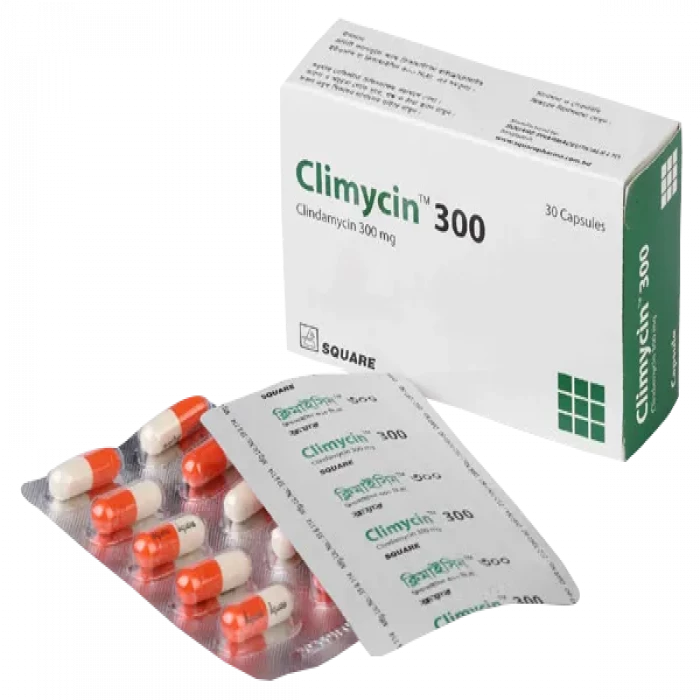
Price in Bangladesh
৳ 15.00 unit price
Price updated: 22 Nov 2026
- Strength
- 300 mg
About Clinacyn 300 mg Capsule
Clinacyn 300 mg is a capsule product of Beximco Pharmaceuticals Ltd. that contains Clindamycin. It may also be used for other infections as determined by your doctor.
There are 45 brands of Clindamycin listed in Bangladesh. 5 of them have a lower unit price than Clinacyn. The lowest listed price is Qcin 150 mg Capsule at ৳ 8.00 per unit.
What is Clinacyn 300 mg Capsule?
Clinacyn 300 mg capsule is a medicine made by Beximco Pharmaceuticals Ltd. Clinacyn is a brand of Clindamycin, an antibiotic that belongs to the macrolide class. Clinacyn 300 mg capsule is an antibiotic medicine containing Clindamycin. Complete the course as prescribed.
Uses of Clinacyn
It may also be used for other infections as determined by your doctor. Only a doctor can decide whether this antibiotic is suitable for a particular infection. Only a doctor can confirm whether your infection is bacterial and whether this antibiotic is appropriate for you. Your doctor will decide if it is right for you.
How to use Clinacyn
Swallow the capsule whole with a full glass of water to help avoid throat irritation. Clinacyn is taken by mouth. Take Clinacyn 300 mg capsule exactly as the doctor tells you. Do not change the dose or stop early without asking the doctor. The dose and how often you take it are decided by your doctor and depend on the type and severity of the infection.
Side effects of Clinacyn
If you experience any side effects, especially severe or persistent ones, contact your doctor. Reported effects include abdominal pain, nausea, vomiting and diarrhoea, as well as itching, skin rashes and hives. Contact your doctor if you notice anything unusual after taking it. Do not stop the medicine without advice.
Safety and precautions
It is contraindicated if you are allergic to Clindamycin or any ingredient of this medicine. In pregnancy, it should be used only if clearly needed; it crosses the placenta. It should be prescribed with caution if you have a history of gastrointestinal disease, especially colitis. Ask your doctor first if any of these apply to you.
Frequently asked questions
What does Clinacyn treat?
It may also be used for other infections as determined by your doctor. Only a doctor can decide whether this antibiotic is suitable for a particular infection.
How is Clinacyn used?
Swallow the capsule whole with a full glass of water to help avoid throat irritation. Clinacyn is taken by mouth.
What are the side effects of Clinacyn?
If you experience any side effects, especially severe or persistent ones, contact your doctor. Reported effects include abdominal pain, nausea, vomiting and diarrhoea, as well as itching, skin rashes and hives.
What is the price of Clinacyn?
The listed price is ৳ 15.00.
Indications
Clindamycin has been shown to be effective in the treatment of the following infections when caused by susceptible anaerobic bacteria or susceptible strains of gram positive bacteria such as Streptococci, Staphylococci and Pneumococci; Upper respiratory infections, Lower respiratory infections, Skin ... Read moreClindamycin has been shown to be effective in the treatment of the following infections when caused by susceptible anaerobic bacteria or susceptible strains of gram positive bacteria such as Streptococci, Staphylococci and Pneumococci; Upper respiratory infections, Lower respiratory infections, Skin and soft tissue infections, Bone and joint infections, Pelvic infections, Intra-abdominal infections, Septicemia and endocarditis, Dental infections. As an alternative therapy when used in combination with quinine or amodiaquine for the treatment of multi-drug resistant Plasmodium falciporum infection.
Dosage & Administration
Dosage of Clindamycin Capsule:
- Serious Infections: 150 mg-300 mg every six hours.
- More severe infections: 300 mg-450 mg every six hours.
To avoid the possibility of oesophageal irritation, Clindacin capsules should be taken with a full glass of water.
Several researches has found that Clindamycin 300 mg capsule provides plasma concentration over MIC
90 for more than 12 hours. This finding supports the twice-daily dosing of Clindacin 300 mg capsule, particularly in SSTIs & RTIs. However, in case of bone & joint infections, diabetic foot infections dose of Clindamycin should be 300 mg capsule 3-4 times daily.
Dosage of Clindamycin Powder for oral solution:
- Serious infections: 8-12 mg/kg/day divided into 3 or 4 equal doses.
- Severe infections: 13-16 mg/kg/day divided into 3 or 4 equal doses.
- More severe infections: 17-25 mg/kg/day divided into 3 or 4 equal doses.
In pediatric patients weighing 10 kg or less, 1/2 teaspoon (37.5 mg) three times a day should be considered the minimum recommended dose.
Dosage of Clindamycin IV/IM Injection:
Adults-
- Serious infections due to aerobic gram-positive cocci and the more susceptible anaerobes: 600-1200 mg/day in 2- 4 equal doses.
- More severe infections: 1200-2700 mg/day in 2-4 equal doses.
- For more serious infections: these doses may have to be increased. In life-threatening situations due to either aerobes or anaerobes, these doses may be increased.
- Doses of as much as 4800 mg daily have been given intravenously to adults. Single intramuscular injections of greater than 600 mg are not recommended.
Neonates (less than 1 month): 15 to 20 mg/kg/day in 3 to 4 equal doses. The lower effective dosage may be adequate for small prematures.
Pediatric patients (1 month of age to 16 years):
- 20 to 40 mg/kg/day in 3 or 4 equal doses. The higher doses would be used for more severe infections.
- Parenteral therapy may be changed to Capsules (clindamycin hydrochloride) when the condition warrants and at the discretion of the physician.
- In cases of (3-hemolytic streptococcal infections, treatment should be continued for at least 10 days.
Interaction
Clindamycin enhances the action of other neuromuscular blocking agents. Therefore, it should be used with caution in patients receiving such agents. Antagonism has been demonstrated between clindamycin and erythromycin in vitro. Because of possible clinical significance, these two drugs should not be administered concurrently.
Contraindications
Clindamycin is contraindicated in patients previously found to be sensitive to clindamycin or any of the ingredients of this medicine.
Side Effects
The adverse effects have been reported with the use of clindamycin are- abdominal pain, oesophagitis and oesophagial ulcer, nausea, vomiting and diarrhoea, pruritus, skin rashes, urticaria.
Pregnancy & Lactation
Pregnancy Category B. Clindamycin crosses the placenta in humans. After multiple doses, amniotic fluid concentrations were approximately 30% of maternal concentrations. Clindamycin should be used in pregnancy only if clearly needed. Clindamycin has been reported to appear in breast milk. Therefore, it is not recommended for nursing mothers if not clearly needed.
Precautions & Warnings
Clindamycin should be prescribed with caution in individuals with a history of gastrointestinal disease, particularly colitis.
Overdose Effects
Overdosage with orally administered clindamycin has been rare. Adverse reactions similar to those seen with normal doses can be expected, however, unexpected reactions could occur. Haemodialysis and peritoneal dialysis are not effective in removing clindamycin from the serum. Overdosage should be treated with simple gastric lavage. No specific antidote is known.
Storage Conditions
Keep below 30°C temperature, away from light & moisture. Keep out of the reach of children.
Medicine information is for reference only and is not medical advice. Always follow your doctor's prescription and check with a pharmacist.