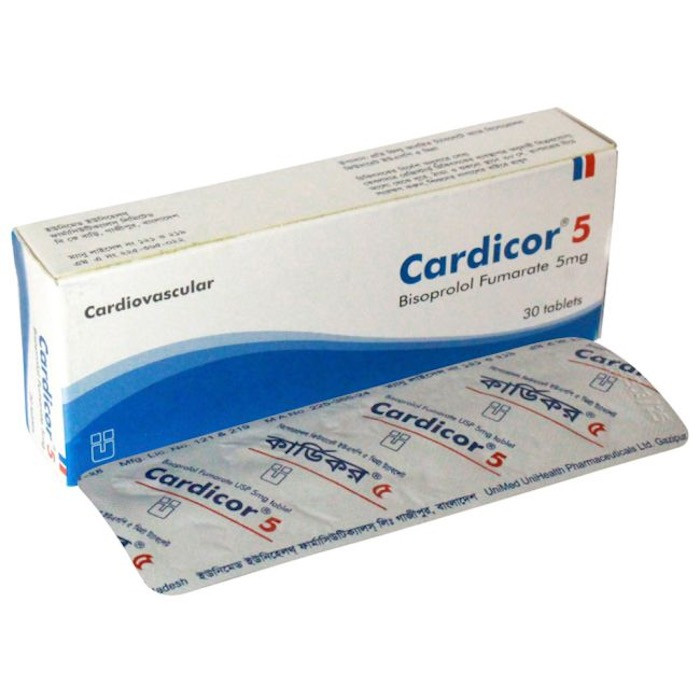
Price in Bangladesh
৳ 11.5 unit price
Price updated: 22 Nov 2026
- Strength
- 5 mg
About Cardicor 5 mg Tablet
The tablet Cardicor contains Bisoprolol Hemifumarate and is made by UniMed UniHealth. It is not for emergency treatment of a hypertensive crisis.
There are 72 brands of Bisoprolol Hemifumarate listed in Bangladesh. 36 of them have a lower unit price than Cardicor. The lowest listed price is Bisoren-1.25 Tablet at ৳ 4 per unit.
What is Cardicor 5 mg Tablet?
Made by UniMed UniHealth, Cardicor is a tablet whose active ingredient is Bisoprolol Hemifumarate. It is used in the management of high blood pressure, angina, and moderate to severe heart failure. Cardicor is taken by mouth; the doctor decides the dose and course.
Uses of Cardicor
It is not for emergency treatment of a hypertensive crisis. Cardicor is used in adults for high blood pressure (hypertension), for angina, and for moderate to severe heart failure. It helps the heart beat more slowly and with less effort. The doctor decides the dose and course based on the patient's condition.
How to use Cardicor
Take it as the doctor or pharmacist explains, and ask them about anything you are unsure of, including what to do if you miss a dose. Swallow the tablet with water. Cardicor is taken by mouth. The dose and how often you take it will be decided by your doctor. Do not stop taking it suddenly without medical advice, as beta-blockers may need careful withdrawal.
Side effects of Cardicor
Like any medicine, Cardicor may cause side effects. Seek medical help right away if you have signs of an allergic reaction such as rash, itching, or swelling. Common ones reported include headache, tiredness, dizziness, diarrhoea, nausea, cough, trouble sleeping, swelling of the ankles, joint pain, sore throat, and signs of nose or sinus inflammation. Tell your doctor if any of these continue for several days.
Safety and precautions
Studies in pregnant women are lacking, so pregnancy and breastfeeding should be discussed with the doctor, who will weigh the benefits. Cardicor is not for people with cardiogenic shock, overt heart failure, certain heart block, right ventricular failure from pulmonary hypertension, or a very slow heart rate. Always inform your doctor of all medicines you take. Tell your doctor if you have kidney, liver or blood problems, as monitoring may be needed during long-term treatment.
Frequently asked questions
Why is Cardicor prescribed?
It is not for emergency treatment of a hypertensive crisis. Cardicor is used in adults for high blood pressure (hypertension), for angina, and for moderate to severe heart failure.
How is Cardicor used?
Take it as the doctor or pharmacist explains, and ask them about anything you are unsure of, including what to do if you miss a dose. Swallow the tablet with water.
What should I watch for while using Cardicor?
Like any medicine, Cardicor may cause side effects. Seek medical help right away if you have signs of an allergic reaction such as rash, itching, or swelling.
What is the price of Cardicor?
The listed price is ৳ 11.5.
Indications
Bisoprolol is indicated in-
- Hypertension
- Angina
- Moderate to severe heart failure
Bisoprolol is not recommended for the emergency treatment of hypertensive crises.
Pharmacology
Bisoprolol Hemifumarate is the most selective ß1 blocker. It displays highest level of affinity for the ß1 receptor than any other beta-blocker available up to now. Selectively blocks ß1 adrenergic receptor in the heart and vascular smooth muscle and reduces heart rate and cardiac output resulting in decrease of arterial hypertension. Lipid metabolism can be adversely affected by ß-blockers, in patients with non-ß1 selective ß1-blocker, but Bisoprolol does not cause any change in the cholesterol fraction including the cardioprotective HDL-cholesterol, in long-term therapy.
Dosage & Administration
Adult: In the treatment of mild to moderate hypertension, Bisoprolol fumarate must be individualized to the needs of the patient. The usual starting dose is 5 mg once daily either added to a diuretic or alone. If the response to 5 mg is inadequate, the dose may be increased to 10 mg and then, if necessary, to 20 mg once daily. An appropriate interval for dose titration is 2 weeks. Increasing the dose beyond 20 mg once daily produces only a small incremental benefit.
Children: Safety and effectiveness in children have not been established.
Patients With Renal or Hepatic Impairment: In patients with hepatic impairment (hepatitis or cirrhosis) or renal dysfunction (creatinine clearance less than 40 mL/min) as in other patients, the initial daily dose should be 5 mg. Because of the possibility of accumulation, caution must be used in dose titration. Since limited data suggest that bisoprolol fumarate is not dialysable, drug replacement is not necessary in patients undergoing dialysis.
Geriatrics: In the elderly, it is not usually necessary to adjust the dose, unless there is also significant renal or hepatic dysfunction
Interaction
Other β-blocking Agents: Bisoprolol fumarate should not be combined with other β-blocking agents.
Catecholamine-Depleting Drugs: Patients receiving catecholamine-depleting drugs, such as reserpine or guanethidine, should be monitored closely because the added β-adrenergic blocking action of bisoprolol fumarate may produce excessive reduction of sympathetic activity.
Centrally Active Antihypertensive Agents: β-blockers may exacerbate the rebound hypertension which can follow the withdrawal of clonidine. If the two drugs are coadministered, the β-blocker should be withdrawn several days before discontinuing clonidine. If replacing clonidine by β-blocker therapy, the introduction of β-blockers should be delayed for several days after clonidine administration has stopped (see also prescribing information for clonidine).
Antiarrhythmic Agents: Bisoprolol fumarate should be used with care when myocardial depressants or inhibitors of A-V conduction, such as certain calcium antagonists (particularly of the phenyl alkylamine (verapamil) and benzothiazepine (diltiazem) classes), or antiarrhythmic agents, such as disopyramide, are used concurrently.
Calcium Channel Blockers: Combined use of β-blockers and calcium channel blockers with negative inotropic effects can lead to prolongation of S-A and A-V conduction, particularly in patients with impaired ventricular function or conduction abnormalities. This may result in severe hypotension, bradycardia and cardiac failure.
Contraindications
In patients with cardiogenic shock, overt heart failure, second or third degree A-V block, right ventricular failure secondary to pulmonary hypertension and sinus bradycardia.
Side Effects
Bisoprolol, like any medication, may have some side effects. It is important that you keep your doctor informed of all side effects especially if you experience one of the following for several days. The most common side effects, whether or not caused by Bisoprolol, are: headache, fatigue, urinary tract infection, rhinitis or sinusitis (inflammation in the nose), diarrhea, dizziness, peripheral edema (swelling of the ankles), joint pain, cough, insomnia (trouble sleeping), nausea (feeling like vomiting), and sore throat. You must seek medical attention immediately if you experience an allergic reaction with symptoms of rash, itching, swelling, dizziness or trouble breathing.
Medicines affect different people in different ways. Just because side effects have occurred in other patients does not mean you will get them. Discuss how you feel on Bisoprolol with your doctor or pharmacist. Do not stop or restart Bisoprolol on your own.
Pregnancy & Lactation
Pregnancy: Bisoprolol fumarate was not teratogenic in rats at doses up to 150 mg/kg/day, which is 375 times the maximum recommended human daily dose. Bisoprolol fumarate was fetotoxic (increased late resorptions) at 50 mg/kg/day and maternotoxic (decreased food intake and body-weight gain) at 150 mg/kg/day. Bisoprolol fumarate was not teratogenic in rabbits at doses up to 12.5 mg/kg/day, which is 31 times the maximum recommended human daily dose, but was embryolethal (increased early resorptions) at 12.5 mg/kg/day. There are no studies in pregnant women. Bisoprolol fumarate should be used during pregnancy only if the potential benefit justifies the potential risk to the fetus.
Lactation: Small amounts of bisoprolol fumarate (<2% of the dose) have been detected in the milk of lactating rats. It is not known whether this drug is excreted in human milk. If use of bisoprolol fumarate is considered essential, then mothers should stop nursing.
Precautions & Warnings
Monitoring of renal, hepatic and hematopoietic function should be performed at regular intervals during long-term treatment with bisoprolol.
Storage Conditions
Keep in a dry place away from light and heat. Keep out of the reach of children.
Medicine information is for reference only and is not medical advice. Always follow your doctor's prescription and check with a pharmacist.