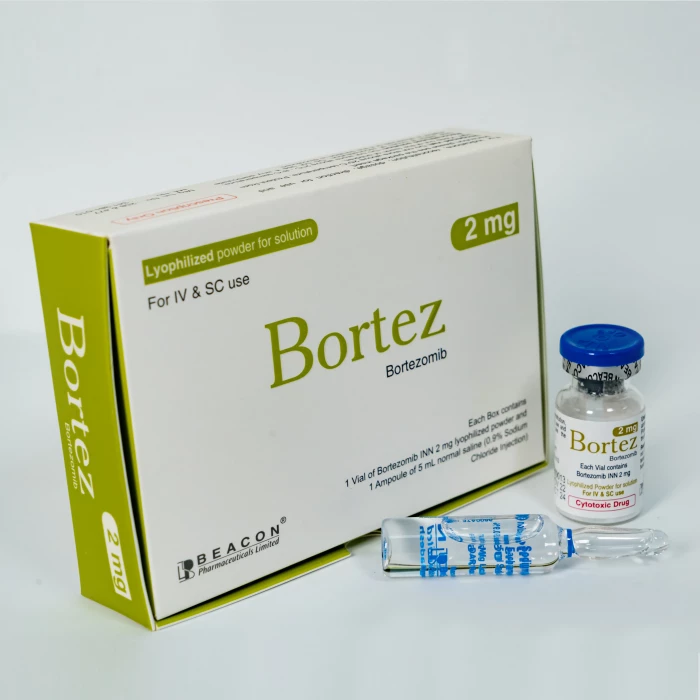
Price in Bangladesh
৳ 12000.00 unit price
Price updated: 22 Nov 2026
- Strength
- 2 mg/vial
About Bortez 2 mg/vial IV/SC Injection
Bortez 2 mg/vial is a iv/sc injection product of Beacon Pharmaceuticals PLC that contains Bortezomib. Bortezomib is a proteasome inhibitor indicated for treatment of patients with multiple myeloma.
What is Bortez 2 mg/vial IV/SC Injection?
The iv/sc injection Bortez contains Bortezomib and is made by Beacon Pharmaceuticals PLC. Bortezomib is a proteasome inhibitor indicated for treatment of patients with multiple myeloma. Bortezomib causes a delay in tumor growth in vivo in nonclinical tumor models, including multiple myeloma. Use it only as your doctor directs.
Uses of Bortez
Bortezomib is a proteasome inhibitor indicated for treatment of patients with multiple myeloma. Ask your doctor whether it is right for your condition.
How to use Bortez
Do not inject it yourself unless a doctor has shown you how. Bortez is given as an injection by a healthcare professional. It can be taken with or without food. If you miss a dose, ask your doctor or pharmacist what to do. Do not change the dose or stop early without asking your doctor.
Side effects of Bortez
Other adverse reactions, including serious adverse reactions, have been reported Tell your doctor if any side effect bothers you or does not go away. Contact your doctor if you notice anything unusual after taking it.
Safety and precautions
Thrombocytopenia or neutropenia can occur; complete blood counts should be regularly monitored throughout treatment. Acute diffuse infiltrative pulmonary disease has been reported. Women should avoid becoming pregnant while being treated with Bortezomib. Ask your doctor first if any of these apply to you.
Frequently asked questions
What is Bortez used for?
Bortezomib is a proteasome inhibitor indicated for treatment of patients with multiple myeloma. Ask your doctor whether it is right for your condition.
How do I use Bortez correctly?
Do not inject it yourself unless a doctor has shown you how. Bortez is given as an injection by a healthcare professional.
What should I watch for while using Bortez?
Other adverse reactions, including serious adverse reactions, have been reported Tell your doctor if any side effect bothers you or does not go away. Contact your doctor if you notice anything unusual after taking it.
What is the price of Bortez?
The listed price is ৳ 12000.00.
Indications
Bortezomib is a proteasome inhibitor indicated for:
- Treatment of patients with multiple myeloma
- Treatment of patients with mantle cell lymphoma who have received at least 1 prior therapy
Pharmacology
Bortezomib is a reversible inhibitor of the chymotrypsin-like activity of the 26S proteasome in mammalian cells. The 26S proteasome is a large protein complex that degrades ubiquitinated proteins. The ubiquitin-proteasome pathway plays an essential role in regulating the intracellular concentration of specific proteins, thereby maintaining homeostasis within cells. Inhibition of the 26S proteasome prevents this targeted proteolysis, which can affect multiple signaling cascades within the cell. This disruption of normal homeostatic mechanisms can lead to cell death. Experiments have demonstrated that bortezomib is cytotoxic to a variety of cancer cell types in vitro. Bortezomib causes a delay in tumor growth in vivo in nonclinical tumor models, including multiple myeloma.
Dosage & Administration
The recommended dose of Bortezomib is 1.3 mg/m2 administered as a 3 to 5 second bolus intravenous injection. Dose adjustment may be used to manage adverse events that occur during treatment
Interaction
Ketoconazole: Co-administration of ketoconazole, a potent CYP3A inhibitor, increased the exposure of bortezomib. Therefore, patients should be closely monitored when given bortezomib in combination with potent CYP3A4 inhibitors (e.g. ketoconazole, ritonavir).
Melphalan-Prednisone: Co-administration of melphalan prednisone increased the exposure of bortezomib. However, this increase is unlikely to be clinically relevant.
Omeprazole: Co-administration of omeprazole, a potent inhibitor of CYP2C19, had no effect on the exposure of bortezomib.
Cytochrome P450: Patients who are concomitantly receiving Bortezomib and drugs that are inhibitors or inducers of cytochrome P450 3A4 should be closely monitored for either toxicities or reduced efficacy
Contraindications
Bortezomib is contraindicated in patients with hypersensitivity to bortezomib, boron, or mannitol
Side Effects
Most commonly reported adverse reactions (incidence ≥30%) in clinical studies include asthenic conditions, diarrhea, nausea, constipation, peripheral neuropathy, vomiting, pyrexia, thrombocytopenia, psychiatric disorders, anorexia and decreased appetite, neutropenia, neuralgia, leukopenia and anemia. Other adverse reactions, including serious adverse reactions, have been reported
Pregnancy & Lactation
Pregnancy Category D. Women of childbearing potential should avoid becoming pregnant while being treated with Bortezomib. Bortezomib administered to rabbits during organogenesis at a dose approximately 0.5 times the clinical dose of 1.3 mg/m2 based on body surface area caused post implantation loss and a decreased number of live fetuses.
Precautions & Warnings
Women should avoid becoming pregnant while being treated with Bortezomib. Pregnant women should be apprised of the potential harm to the fetus
Peripheral neuropathy, including severe cases, may occur - manage with dose modification or discontinuation. Patients with preexisting severe neuropathy should be treated with Bortezomib only after careful risk-benefit assessment.
Hypotension can occur. Caution should be used when treating patients receiving antihypertensives, those with a history of syncope, and those who are dehydrated.
Patients with risk factors for, or existing heart disease, should be closely monitored.
Acute diffuse infiltrative pulmonary disease has been reported.
Nausea, diarrhea, constipation, and vomiting have occurred and may require use of antiemetic and antidiarrheal medications or fluid replacement.
Thrombocytopenia or neutropenia can occur; complete blood counts should be regularly monitored throughout treatment.
Tumor Lysis Syndrome, Reversible Posterior Leukoencephalopathy Syndrome, and acute hepatic failure have been reported.
Storage Conditions
Unopened vials may be stored at controlled room temperature 25º C
Medicine information is for reference only and is not medical advice. Always follow your doctor's prescription and check with a pharmacist.