Price in Bangladesh
৳ 45.00 unit price
Price updated: 22 Nov 2026
- Strength
- 0.05%
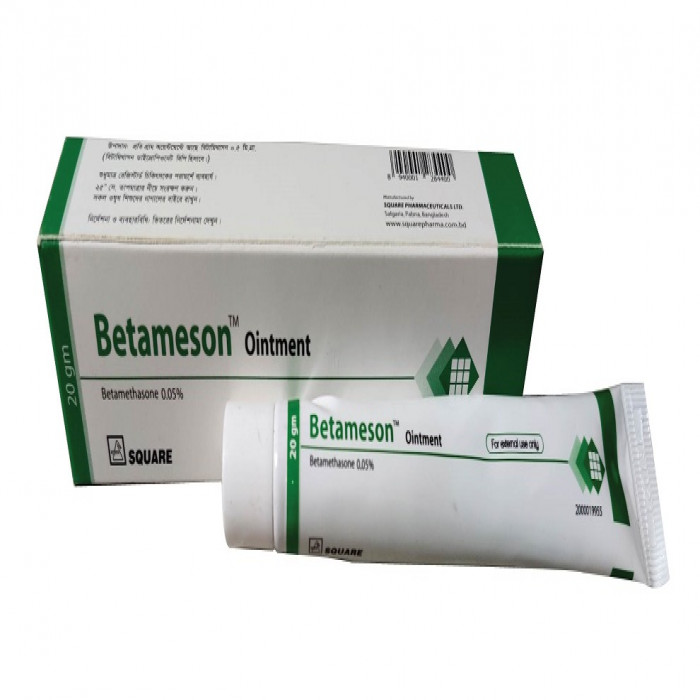
About Betameson 0.05% Cream
Made by Square Pharmaceuticals Ltd., Betameson is a cream whose active ingredient is Betamethasone Dipropionate. Betamethasone Dipropionate cream and ointment is indicated for the relief of the inflammatory and pruritic manifestations of resistant or severe corticosteroid-responsive dermatoses.
What is Betameson 0.05% Cream?
Betameson 0.05% is a cream product of Square Pharmaceuticals Ltd. that contains Betamethasone Dipropionate. Betamethasone Dipropionate is a topical corticosteroid with anti-inflammatory, antipruritic and vasoconstrictive properties. Betamethasone Dipropionate cream and ointment is indicated for the relief of the inflammatory and pruritic manifestations of resistant or severe corticosteroid-responsive dermatoses. The doctor decides the dose and course.
Uses of Betameson
Betamethasone Dipropionate cream and ointment is indicated for the relief of the inflammatory and pruritic manifestations of resistant or severe corticosteroid-responsive dermatoses. Ask your doctor whether it is right for your condition.
How to use Betameson
Wash your hands before and after applying it. Apply Betameson only to the skin, as directed by your doctor. Betameson 0.05% cream is taken by mouth. Do not change the dose or stop early without asking your doctor. If you miss a dose, ask your doctor or pharmacist what to do.
Side effects of Betameson
The most frequent side effects reported with Betamethasone Dipropionate are mild to moderate transient burning/stinging, dry skin, pruritus, irritation and folliculitis. Adverse reactions reported with the use of the Betamethasone Dipropionate ointment pulse dose regimen were mild intermittent hypertension and paraesthesia. Contact your doctor if you notice anything unusual after taking it. Tell your doctor if any side effect bothers you or does not go away.
Safety and precautions
Betamethasone Dipropionate is not intended for use under occlusive dressings since this will also increase systemic absorption of the corticosteroid. Hypersensitivity to Betamethasone Dipropionate, other corticosteroids or any components in this preparation. Corticosteroids are known to be absorbed percutaneously, therefore in patients under prolonged and extensive topical treatment, the possibility of systemic effects should be kept in mind. Ask your doctor first if any of these apply to you.
Frequently asked questions
What is Betameson used for?
Betamethasone Dipropionate cream and ointment is indicated for the relief of the inflammatory and pruritic manifestations of resistant or severe corticosteroid-responsive dermatoses. Ask your doctor whether it is right for your condition.
How is Betameson used?
Wash your hands before and after applying it. Apply Betameson only to the skin, as directed by your doctor.
What should I watch for while using Betameson?
The most frequent side effects reported with Betamethasone Dipropionate are mild to moderate transient burning/stinging, dry skin, pruritus, irritation and folliculitis. Adverse reactions reported with the use of the Betamethasone Dipropionate ointment pulse dose regimen were mild intermittent hypertension and paraesthesia.
What is the price of Betameson?
The listed price is ৳ 45.00.
Indications
Betamethasone Dipropionate cream and ointment is
indicated for the relief of the inflammatory and pruritic manifestations of resistant or severe corticosteroid-responsive dermatoses. These include-
- Atopic eczema
- Nummular eczema
- Contact dermatitis
- Neurodermatitis
- Anogenital and senile pruritus
- Lichen planus
- Psoriasis
Pharmacology
Betamethasone Dipropionate is a topical corticosteroid with anti-inflammatory, antipruritic and vasoconstrictive properties. Betamethasone Dipropionate induces peptides called lipocortins. Lipocortins antagonize phospholipase A2, an enzyme that causes the breakdown of leukocyte lysosomal membranes to release arachidonic acid. This action decreases the subsequent formation and release of endogenous inflammatory mediators including prostaglandins, kinins, histamine.
Pharmacokinetics: Betamethasone Dipropionate can be absorbed from normal intact skin. Corticosteroids are bound to plasma proteins in varying degrees. Corticosteroids are metabolized primarily in the liver.lt excreted by the kidneys.
Dosage & Administration
Apply a thin film once or twice daily to cover completely the affected area. Patients with chronic psoriasis who have achieved at least a marked improvement in their psoriatic lesion (i.e., approximately 80% improvement) with Betamethasone Dipropionate may be maintained in remission with a pulse dosing regimen consisting of three consecutive applications of up to 3.5 g each of Betamethasone Dipropionate cream and ointment, twelve hours apart (e.g., morning, evening, following morning) to the previously affected areas once each week. For this purpose, Betamethasone Dipropionate cream and ointment should be applied to the lesion sites previously affected and treated. Patients on this pulse dose regimen who relapse should be reverted back to the conventional dosing regimen.
Interaction
There is no evidence of any kind of interaction.
Contraindications
Hypersensitivity to Betamethasone Dipropionate, other corticosteroids or any components in this preparation. Like other topical corticosteroids, Betamethasone Dipropionate is contraindicated in viral infections of the skin, such as vaccinia, varicella and Herpes simplex, also tuberculosis, acne rosacea, fungal skin infections (moniliasis), perioral dermatitis and ulcerative conditions.
Side Effects
The most frequent side effects reported with Betamethasone Dipropionate are mild to moderate transient burning/stinging, dry skin, pruritus, irritation and folliculitis. Rarely reported adverse effects include tingling, prickly skin/tightening or cracking of skin, warm feeling,laminar scaling and perilesional scaling,follicular rash, skin atrophy, erythema, urticaria, vesiculation, telangiectasia, acneiform papules and hyperaesthesia.
Adverse reactions reported with the use of the Betamethasone Dipropionate ointment pulse dose regimen were mild intermittent hypertension and paraesthesia. Other local adverse reactions that have been reported with the use of topical corticosteroids include: itching, hypertrichosis, hypopigmentation, perioral dermatitis, allergic contact dermatitis, maceration of the skin, secondary infection, striae, miliaria and exacerbation of untreated infections
Precautions & Warnings
Betamethasone Dipropionate should not be used in or near the eyes, as there is a potential risk of developing glaucoma and cataract. If irritation or sensitisation develops with the use of Betamethasone Dipropionate, treatment should be discontinued and appropriate therapy instituted. In the presence of an infection, an appropriate antifungal or antibacterial agent should be administered. If a favourable response does not occur promptly, Betamethasone Dipropionate should be discontinued until the infection has been controlled adequately.
Corticosteroids are known to be absorbed percutaneously, therefore in patients under prolonged and extensive topical treatment, the possibility of systemic effects should be kept in mind. Betamethasone Dipropionate is not intended for use under occlusive dressings since this will also increase systemic absorption of the corticosteroid. In infants the napkin may act as an occlusive dressing and increase absorption. Suitable precautions should be taken when using topical corticosteroids in patients with stasis dermatitis and other skin diseases with impaired circulation. Prolonged use of topical corticosteroid preparations may produce striae or atrophy of the skin or subcutaneous tissue. If this occurs, treatment should be discontinued.
Overdose Effects
Acute overdose with the ointment is unlikely and would not be expected to lead to a life-threatening situation. The ointment should not be used for longer than the prescribed time period.
Storage Conditions
Keep below 30°C temperature, away from light & moisture. Keep out of the reach of children.
Medicine information is for reference only and is not medical advice. Always follow your doctor's prescription and check with a pharmacist.