Price in Bangladesh
৳ 11.5 unit price
Price updated: 22 Nov 2026
- Strength
- 5 mg
About Betacor 5 mg Tablet
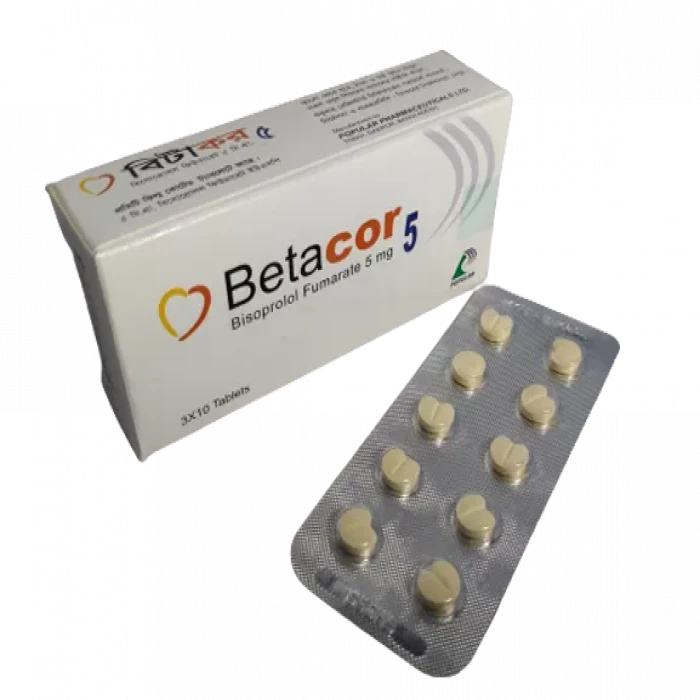
Betacor comes as a tablet with 5 mg of Bisoprolol Hemifumarate, from Popular Pharmaceuticals Ltd. It is a beta blocker that helps reduce heart rate and cardiac output, lowering blood pressure.
There are 72 brands of Bisoprolol Hemifumarate listed in Bangladesh. 36 of them have a lower unit price than Betacor. The lowest listed price is Bisoren-1.25 Tablet at ৳ 4 per unit.
What is Betacor 5 mg Tablet?
Betacor comes as a tablet with 5 mg of Bisoprolol Hemifumarate, from Popular Pharmaceuticals Ltd. The medicine works by reducing heart rate and cardiac output, which helps lower blood pressure. It is used to treat high blood pressure, angina (chest pain), and moderate to severe heart failure. Use it only as your doctor directs.
Uses of Betacor
It is a beta blocker that helps reduce heart rate and cardiac output, lowering blood pressure. It is a beta blocker, a type of anti-adrenergic medicine that reduces heart rate and cardiac output. It is not intended for immediate relief of a hypertensive crisis. Your doctor will decide if it is suitable for you.
How to use Betacor
Take it as the doctor or pharmacist explains, and ask them about anything you are unsure of, including what to do if you miss a dose. Swallow the tablet with water. Betacor is taken by mouth. Do not attempt to use it yourself. Do not change the dose or stop taking this medicine without consulting your doctor, as sudden stopping can worsen your condition. If you miss a dose, ask the doctor or pharmacist what to do rather than doubling up.
Side effects of Betacor
Some people may have urinary tract infections. The most common ones include headache, tiredness, dizziness, diarrhea, nausea, cough, trouble sleeping, sore throat, swelling of the ankles, joint pain, and signs of urinary tract or sinus infection. Tell your doctor if any side effect lasts for several days or bothers you. Ask your doctor about any other effect that worries you.
Safety and precautions
Your doctor may monitor your kidney, liver, and blood counts during long-term treatment. Do not take this medicine if you have certain heart conditions such as cardiogenic shock, overt heart failure, second or third degree heart block, right ventricular failure from pulmonary hypertension, or a very slow heart rate. If you are pregnant, planning a pregnancy or breastfeeding, ask your doctor before taking it.
Frequently asked questions
Why is Betacor prescribed?
It is a beta blocker that helps reduce heart rate and cardiac output, lowering blood pressure. It is a beta blocker, a type of anti-adrenergic medicine that reduces heart rate and cardiac output.
How should I take Betacor?
Take it as the doctor or pharmacist explains, and ask them about anything you are unsure of, including what to do if you miss a dose. Swallow the tablet with water.
What should I watch for while using Betacor?
Some people may have urinary tract infections. The most common ones include headache, tiredness, dizziness, diarrhea, nausea, cough, trouble sleeping, sore throat, swelling of the ankles, joint pain, and signs of urinary tract or sinus infection.
What is the price of Betacor?
The listed price is ৳ 11.5.
Indications
Bisoprolol is indicated in-
- Hypertension
- Angina
- Moderate to severe heart failure
Bisoprolol is not recommended for the emergency treatment of hypertensive crises.
Pharmacology
Bisoprolol Hemifumarate is the most selective ß1 blocker. It displays highest level of affinity for the ß1 receptor than any other beta-blocker available up to now. Selectively blocks ß1 adrenergic receptor in the heart and vascular smooth muscle and reduces heart rate and cardiac output resulting in decrease of arterial hypertension. Lipid metabolism can be adversely affected by ß-blockers, in patients with non-ß1 selective ß1-blocker, but Bisoprolol does not cause any change in the cholesterol fraction including the cardioprotective HDL-cholesterol, in long-term therapy.
Dosage & Administration
Adult: In the treatment of mild to moderate hypertension, Bisoprolol fumarate must be individualized to the needs of the patient. The usual starting dose is 5 mg once daily either added to a diuretic or alone. If the response to 5 mg is inadequate, the dose may be increased to 10 mg and then, if necessary, to 20 mg once daily. An appropriate interval for dose titration is 2 weeks. Increasing the dose beyond 20 mg once daily produces only a small incremental benefit.
Children: Safety and effectiveness in children have not been established.
Patients With Renal or Hepatic Impairment: In patients with hepatic impairment (hepatitis or cirrhosis) or renal dysfunction (creatinine clearance less than 40 mL/min) as in other patients, the initial daily dose should be 5 mg. Because of the possibility of accumulation, caution must be used in dose titration. Since limited data suggest that bisoprolol fumarate is not dialysable, drug replacement is not necessary in patients undergoing dialysis.
Geriatrics: In the elderly, it is not usually necessary to adjust the dose, unless there is also significant renal or hepatic dysfunction
Interaction
Other β-blocking Agents: Bisoprolol fumarate should not be combined with other β-blocking agents.
Catecholamine-Depleting Drugs: Patients receiving catecholamine-depleting drugs, such as reserpine or guanethidine, should be monitored closely because the added β-adrenergic blocking action of bisoprolol fumarate may produce excessive reduction of sympathetic activity.
Centrally Active Antihypertensive Agents: β-blockers may exacerbate the rebound hypertension which can follow the withdrawal of clonidine. If the two drugs are coadministered, the β-blocker should be withdrawn several days before discontinuing clonidine. If replacing clonidine by β-blocker therapy, the introduction of β-blockers should be delayed for several days after clonidine administration has stopped (see also prescribing information for clonidine).
Antiarrhythmic Agents: Bisoprolol fumarate should be used with care when myocardial depressants or inhibitors of A-V conduction, such as certain calcium antagonists (particularly of the phenyl alkylamine (verapamil) and benzothiazepine (diltiazem) classes), or antiarrhythmic agents, such as disopyramide, are used concurrently.
Calcium Channel Blockers: Combined use of β-blockers and calcium channel blockers with negative inotropic effects can lead to prolongation of S-A and A-V conduction, particularly in patients with impaired ventricular function or conduction abnormalities. This may result in severe hypotension, bradycardia and cardiac failure.
Contraindications
In patients with cardiogenic shock, overt heart failure, second or third degree A-V block, right ventricular failure secondary to pulmonary hypertension and sinus bradycardia.
Side Effects
Bisoprolol, like any medication, may have some side effects. It is important that you keep your doctor informed of all side effects especially if you experience one of the following for several days. The most common side effects, whether or not caused by Bisoprolol, are: headache, fatigue, urinary tract infection, rhinitis or sinusitis (inflammation in the nose), diarrhea, dizziness, peripheral edema (swelling of the ankles), joint pain, cough, insomnia (trouble sleeping), nausea (feeling like vomiting), and sore throat. You must seek medical attention immediately if you experience an allergic reaction with symptoms of rash, itching, swelling, dizziness or trouble breathing.
Medicines affect different people in different ways. Just because side effects have occurred in other patients does not mean you will get them. Discuss how you feel on Bisoprolol with your doctor or pharmacist. Do not stop or restart Bisoprolol on your own.
Pregnancy & Lactation
Pregnancy: Bisoprolol fumarate was not teratogenic in rats at doses up to 150 mg/kg/day, which is 375 times the maximum recommended human daily dose. Bisoprolol fumarate was fetotoxic (increased late resorptions) at 50 mg/kg/day and maternotoxic (decreased food intake and body-weight gain) at 150 mg/kg/day. Bisoprolol fumarate was not teratogenic in rabbits at doses up to 12.5 mg/kg/day, which is 31 times the maximum recommended human daily dose, but was embryolethal (increased early resorptions) at 12.5 mg/kg/day. There are no studies in pregnant women. Bisoprolol fumarate should be used during pregnancy only if the potential benefit justifies the potential risk to the fetus.
Lactation: Small amounts of bisoprolol fumarate (<2% of the dose) have been detected in the milk of lactating rats. It is not known whether this drug is excreted in human milk. If use of bisoprolol fumarate is considered essential, then mothers should stop nursing.
Precautions & Warnings
Monitoring of renal, hepatic and hematopoietic function should be performed at regular intervals during long-term treatment with bisoprolol.
Storage Conditions
Keep in a dry place away from light and heat. Keep out of the reach of children.
Medicine information is for reference only and is not medical advice. Always follow your doctor's prescription and check with a pharmacist.